


How to Choose a Luxury Home Builder in Australia: A 2026 Guide
Updated: Oct 9
What if the most impressive portfolio isn’t the clearest sign that a builder can bring your vision to life? Knowing how to choose a luxury home builder in Australia means looking beyond polished imagery and promises to understand how a builder listens, develops your brief and carries design decisions through to construction.
Builders can be difficult to compare when each presents its work differently. If scope, communication and responsibilities aren’t clear, even a carefully considered design can feel vulnerable to compromise. A well-defined process should offer clarity as well as craftsmanship, so you know what to expect at each stage of a significant personal investment.
This guide provides a practical checklist for assessing design capability, project delivery, transparency and fit. You’ll learn what evidence to review before signing, which questions can clarify scope and decision-making, and how to assess whether a builder can support an individual brief from concept to completion. Carmel Homes is a family-owned Australian builder with over 30 years of experience. Its design-and-build service includes full-service project management, connecting your ambitions with the work of creating a home.
Table of Contents
How to choose a luxury home builder in Australia: start with the right fit
How to assess a luxury builder’s design skill and construction capability
How to compare luxury home builder proposals, scope and contracts
Luxury home builder checklist: due diligence before you commit
How Carmel Homes brings a bespoke luxury build from vision to completion
How to choose a luxury home builder in Australia: start with the right fit
A prestigious portfolio can inspire, but it can’t show on its own whether a builder’s approach suits your household, site and expectations. When considering how to choose a luxury home builder in Australia, look for alignment between the home you want and the process that will bring it to life.
Luxury building involves more than selecting premium finishes. It brings together bespoke design, considered craftsmanship, tailored service and project coordination. Compare a home shaped around an individual brief, where layout, detailing and materials respond to the people who will live there, with a standardised plan personalised mainly through finish selections.
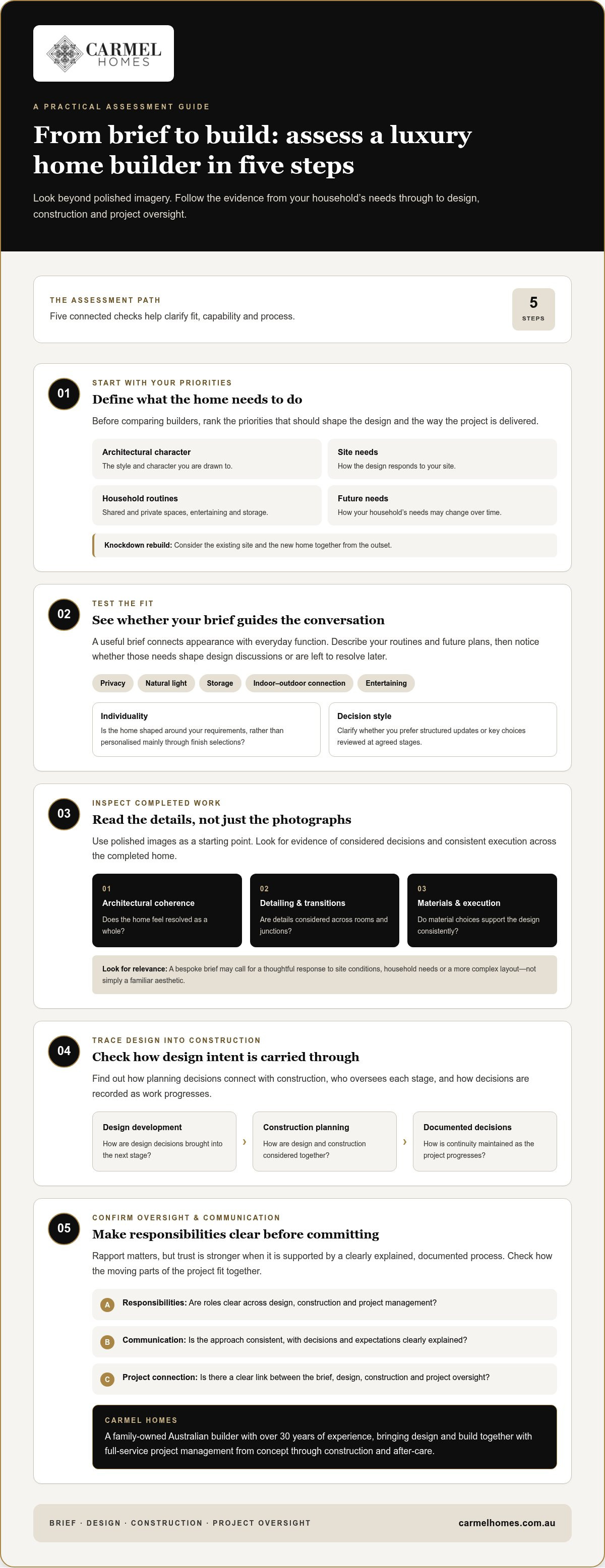
Before comparing builders, rank your priorities. Note the architectural character you’re drawn to, the needs of your site, how your household uses shared and private spaces, and how those needs might change over time. For a knockdown rebuild , consider the existing site and the new home together from the outset.
What should a luxury home builder understand about your brief?
A useful brief connects appearance with everyday function. French Provincial details or a modern architectural style may matter, but so do privacy, entertaining, storage, natural light and the relationship between indoor and outdoor spaces. Describe your daily routines and future plans, then see whether those priorities shape the design discussion or are left to resolve later. Early clarity helps connect design decisions with project expectations.
How do you assess whether a builder is the right fit?
Think about how you prefer to make decisions. Do you want regular, structured updates, or would you rather review key choices at agreed stages? The builder’s communication process should clarify responsibilities and show how design, construction and project management fit together. Rapport matters in a bespoke project, but trust is stronger when it is supported by a clear, documented process.
Carmel Homes brings design and build together, managing projects from concept through construction and after-care with full-service project management. As a family-owned Australian builder with over 30 years of experience, it takes an individually tailored approach rather than relying on a one-size-fits-all brief.
Use this shortlist consistently as you assess fit:
Brief: Do your style, site, household routines and longer-term needs guide the design?
Individuality: Is the home shaped around your requirements, rather than personalised only through finish selections?
Communication: Are the decision-making process and project responsibilities clearly explained?
Coordination: Is there a clear connection between design, construction and project management?
How to assess a luxury builder’s design skill and construction capability
Beautiful photography can establish a mood, but it can’t show all the thinking or workmanship behind a completed home. As you consider how to choose a luxury home builder in Australia, look for evidence that design quality is matched by the ability to coordinate details, materials and construction around a specific brief.
What should you look for in a luxury home portfolio?
Review completed projects for more than an appealing façade or interior palette. Consider whether each home feels architecturally coherent, whether details are resolved across rooms and transitions, and whether material choices support the overall design. A gallery of similar-looking homes may demonstrate a recognisable aesthetic, but a bespoke brief can require a different capability: responding thoughtfully to site conditions, household needs or a more complex layout.
Use polished images as a starting point, not the whole assessment. Look closely at proportions, junctions and how finishes work together. Ask whether the completed work shows considered decisions and consistent execution, not just whether you like the result.
How can you assess design-to-build continuity?
Design intent can be lost if decisions made during planning aren’t carried clearly into construction. Find out how design development connects with construction planning, who oversees each stage, and how decisions are recorded as the project progresses. A design-and-build approach can bring these responsibilities together, while clear project management helps maintain continuity between the brief, documentation and delivery.
Use the comparison below to organise the evidence you review. Credentials or industry memberships can provide context, but they don’t replace relevant completed work or a clearly explained process.
Carmel Homes’ design-and-build service connects the client brief with construction and full-service project management. Its work includes individually designed homes and knockdown rebuilds , where the design needs to respond to the site and project requirements. Explore Carmel Homes’ custom design and build approach to see how these elements are brought together.
How to compare luxury home builder proposals, scope and contracts
A headline figure can look decisive, but proposals may describe different homes, materials, design work or levels of project oversight. To understand how to choose a luxury home builder in Australia, compare what each proposal commits to delivering rather than treating the bottom line as a like-for-like measure.
Use a comparison table to make differences visible. Record what is documented and separate it from assumptions or verbal discussions that still need to be resolved. For each allowance, exclusion or future decision, note what it covers and how it could affect the agreed scope.
Record variation procedures and any stated decision deadlines too. These details affect how changes are considered and responsibilities understood as the project advances. Keep confirmed contract terms separate from informal statements, and have important clarifications documented before relying on them.
What should you understand before signing a building contract?
Read the full contract, not just the summary. Check how the agreed scope is described, how payment stages are set out, what process applies to variations, which timelines and milestones are recorded, and how disputes are addressed. If an allowance or exclusion is unclear, understand how it is treated before signing rather than assuming it is included.
Building requirements in Australia can vary by state and territory, including the applicable adoption and timing of national requirements. The National Construction Code provides the national framework, but check current requirements with the relevant state or territory regulator and obtain advice suited to your project. The Australian Consumer Law may also be relevant to consumer protections. A suitably qualified legal or building adviser can help you understand the contract and applicable obligations. This is especially valuable where significant design choices, responsibilities or assumptions remain unresolved.
Luxury home builder checklist: due diligence before you commit
A considered shortlist helps distinguish an appealing first impression from a process you can rely on. As you assess how to choose a luxury home builder in Australia, apply the same checks to each candidate, record the responses and resolve material differences before making a commitment.
What questions should you resolve before selecting a builder?
Ask how the builder guides clients from the initial brief through design, construction and after-care. Discuss how updates are shared, how decisions and variations are recorded, and who is responsible for each stage. Review completed work relevant to your intended project, looking at both its appearance and the design or site requirements it demonstrates.
Keep a consistent record for each builder. Note what is clearly explained, what is documented and what remains open for clarification. This makes it easier to compare the substance of each response rather than relying on memory or presentation.
Experience: Does the builder’s background relate to the design, site or project type you have in mind?
Completed work: Do examples show considered design, detailing and construction relevant to your brief?
Communication: Are updates, decisions and variations explained in a way that suits your preferred involvement?
Responsibilities: Are roles across design, construction and project management clearly set out?
Credentials and requirements: Have relevant credentials and current regulatory requirements been checked against official guidance for the applicable state or territory?
Which warning signs deserve a closer look?
Vague scope, inconsistent explanations or undocumented changes deserve clarification before you proceed. They aren’t necessarily evidence of a deeper problem; a detail may simply be unresolved. The key is whether the builder can explain it clearly and put material decisions or responsibilities in writing. If significant uncertainty remains, pause before committing and seek appropriately qualified advice where needed.
For a knockdown rebuild, the relationship between the site, design brief and proposed work should be clear enough for you to understand what is being considered and who is responsible for key decisions. The same principle applies to any bespoke project: clarity at the outset supports a more assured progression from concept to completion.
Carmel Homes connects the brief, construction and full-service project management through its design-and-build service, with project care from concept through construction and after-care. Explore Carmel Homes’ custom design-and-build approach.
How Carmel Homes brings a bespoke luxury build from vision to completion
A considered building experience carries the homeowner’s intentions through each stage, rather than treating design and construction as separate decisions. Carmel Homes is a family-owned Australian luxury home builder with over 30 years of experience. Its bespoke design-and-build engagement spans concept, construction and after-care.
What does Carmel Homes’ design-and-build service include?
The process begins with the brief: the character you want your home to express, how you intend to live in it and the particular needs of the project. Carmel Homes develops a tailored design around those considerations, then connects the design with construction through full-service project management. After-care is part of the wider engagement, extending the relationship beyond the building phase.
This integrated approach gives the brief a clear place in the overall project. Instead of making design choices in isolation, homeowners can consider how their desired spaces and architectural character relate to the practical work of bringing the home to life.
When might a bespoke project suit your plans?
Custom design can be a considered option when a standardised plan doesn’t reflect your priorities, or when the site and household brief call for an individual response. Carmel Homes creates French Provincial luxury homes , modern custom home designs and Hampton style homes , as well as dual occupancy and knockdown rebuild projects. The right direction depends on your property plans and the home you want to create.
For a knockdown rebuild, consider the existing home, site, new design and intended way of living together. Exploring the knockdown rebuild process can help you define the project type before shaping your brief. For dual occupancy, your brief may need to balance distinct living arrangements with the way the overall property is planned.
The principles in this guide offer a practical way to assess whether a builder’s experience, design approach and project coordination align with your ambitions. They also help focus the conversation on what matters to you, whether that is architectural character, the needs of your site or a home shaped around changing household plans.
If you’re ready to explore an individually designed home, Carmel Homes can discuss your brief and its design-and-build approach. A considered conversation can help you begin shaping your vision into a residence that feels distinctly your own.
Choose a process that protects your vision
Knowing how to choose a luxury home builder in Australia involves more than finding a striking portfolio. Look for a considered fit: a builder whose design capability reflects your brief, whose process connects design with construction, and whose scope, responsibilities and communication are clearly documented.
Compare completed work for relevant experience and workmanship. Assess proposals beyond their headline figures by reviewing inclusions, exclusions, assumptions and contract terms. Before committing, resolve significant uncertainties and seek qualified advice on the agreement and requirements that apply to your project.
Carmel Homes is a family-owned luxury custom home builder with over 30 years of experience in Australia. Its bespoke design-and-build service takes a home from concept through construction and after-care, with full-service project management supporting the process. If you’re ready to explore how your ideas could take shape, discuss your home vision with Carmel Homes.
A well-chosen building partnership can give your individual brief the clarity and care it deserves, helping you move towards a home that feels distinctly your own.
Frequently Asked Questions
How do I choose a luxury home builder in Australia?
To choose a luxury home builder in Australia, compare relevant completed projects, design capability, communication, project management and documented scope. Use the same checklist for each shortlisted builder, recording what’s included and which assumptions remain unresolved. Clarify those assumptions before committing and seek suitably qualified advice on contract terms and applicable regulatory questions. The strongest fit is a builder whose documented process can support your individual brief from design through construction.
What should I look for in a luxury home builder’s portfolio?
Look beyond polished photography to assess design coherence, detailing, material choices and the range of project requirements represented. A useful portfolio shows how a builder has translated different briefs into considered homes, rather than presenting one visual style alone. Compare relevant examples with your design priorities, such as architectural character or a site-specific response. Treat images as one part of due diligence, not proof of every claim about project delivery or workmanship.
Is a custom home builder better than a volume builder for a luxury home?
Neither model is universally better. The right fit depends on how individual you want the design to be and how you prefer decisions and project coordination to work. A bespoke service can suit a distinctive brief that calls for a tailored response, while a more standardised model may suit different priorities. Compare design flexibility, scope, communication and delivery responsibilities against your needs, then choose the approach that aligns with the home you intend to create.
What questions should I ask a luxury home builder before signing?
Ask how the design brief is developed, who manages each project stage, and how decisions and variations are recorded. Clarify what the proposal includes and excludes, how updates are communicated, and which responsibilities sit with you. Before signing, understand the proposed payment stages, timelines and dispute process. If contract terms or requirements specific to your state or territory are unclear, seek advice from a suitably qualified adviser before making a commitment.
How can I compare luxury home builder quotes fairly?
Compare proposals by documented scope, not by headline amount alone. Check design deliverables, materials, inclusions, exclusions, assumptions, allowances, project management and variation processes. Record differences side by side, separating confirmed details from unresolved points, and seek clear documentation before deciding. Avoid relying on generic price ranges: assess a bespoke project against its own brief and the scope set out in each proposal.
What should a luxury home builder contract include?
A building contract should clearly document the agreed scope, responsibilities, payment stages, variation process, timelines, communication arrangements and dispute processes. These details help you understand what has been agreed and how decisions may be managed as the project progresses. Contract requirements and consumer protections can depend on current rules and the applicable jurisdiction. This overview isn’t legal advice, so have the contract reviewed by a suitably qualified adviser before signing.
How long does it take to build a luxury custom home in Australia?
There’s no single timeframe that applies to every Australian custom home. Timing can depend on design development, approvals, site conditions, scope, material selections and construction complexity. Rather than relying on a general estimate, review the project programme and its key dependencies for your brief. Ongoing communication can help you understand progress, upcoming decisions and any changes to the sequence as the project moves from design into construction.


