


Builder's Warranty Insurance: Cover, Claims and State Rules
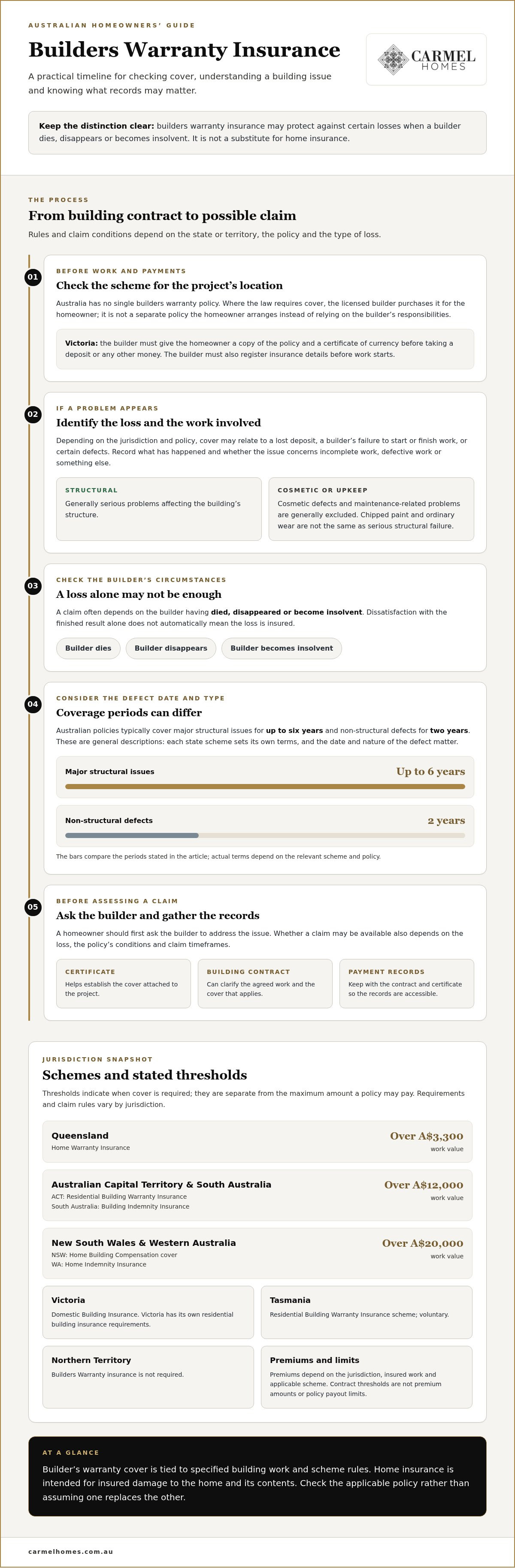
A home warranty policy isn’t a substitute for home insurance: it’s designed to protect homeowners in certain circumstances when building work goes wrong and the builder can’t resolve it. Depending on the state or territory, it may cover a lost deposit, unfinished work or defects when a builder dies, disappears or becomes insolvent. In Queensland, Home Warranty Insurance is required for work valued over A$3,300, according to the Queensland Building and Construction Commission.
It’s understandable to expect insurance connected with a new home to protect the building itself, but cover and claim conditions depend on the policy and local rules. This guide explains builder’s warranty insurance in Australia, including what it may cover, how requirements differ across states and territories, and how it compares with home insurance.
You’ll also learn when a claim may be possible, why the insurance certificate and building contract matter, and what homeowners should know about defects and incomplete work. Understanding these distinctions helps you assess the protections attached to a build and the role each type of insurance plays.
Table of Contents
What is Builders Warranty insurance?
Across Australia, state and territory schemes provide a measure of consumer protection for domestic building work. The policy name and claim rules vary by jurisdiction.
Builder responsibility for cover
Where the law requires Builders Warranty insurance for a project, the licensed builder purchases the cover for the homeowner. It is not a separate policy the homeowner arranges instead of relying on the builder’s responsibilities.
This matters before money changes hands: the cover relates to the building work and risks specified by the relevant scheme. It may respond if a builder fails to start or finish the job, but only in circumstances set out in the policy. The builder’s role in obtaining cover does not mean every defect or loss is automatically insured.
Defects and coverage duration
Builders Warranty insurance may cover defective work on a completed home if the builder has died, disappeared or become insolvent. Structural defects generally involve serious problems affecting the building’s structure, rather than surface appearance or routine upkeep.
Australian policies typically cover major structural issues for up to six years and non-structural defects for two years, although each state scheme sets its own terms. The date and nature of a defect therefore matter. A structural problem and a cosmetic imperfection may be treated differently, even if both appear after completion.
What the insurance covers
Depending on the jurisdiction and policy, Builders Warranty insurance may cover a lost deposit, a builder’s failure to start or complete work, or certain defects. A claim often depends on the builder’s death, disappearance or insolvency, rather than dissatisfaction with the finished result alone.
Home warranty insurance is a common name for state-based consumer protection linked to residential building work. Subject to local eligibility rules and claim conditions, it may cover losses such as incomplete or defective work. Australian policies generally exclude cosmetic defects and maintenance-related problems, so chipped paint or ordinary wear should not be treated like a serious structural failure.
For homeowners, the practical step is to identify the problem, the builder’s circumstances and the applicable scheme. These details help clarify whether the issue involves an insured loss, work the builder may need to address, or routine maintenance.
Proof of cover before work
Proof of cover records the policy attached to the project and can help establish the basis for a claim. In Victoria, a builder must give the homeowner a copy of the policy and a certificate of currency before taking a deposit or any other money.
Victorian builders must also register their insurance details before work starts. Keep the certificate with the signed building contract and payment records so the documents are accessible if a dispute or claim arises. The builder should provide the Builders Warranty certificate needed to make a claim.
These records connect the insured property and building work to the policy. If an issue arises later, the certificate and contract can clarify the agreed work and the cover that applies.
State and territory insurance requirements
Australia has no single builders warranty policy: each state or territory sets its own scheme, threshold and conditions. Minimum contract values and cover limits vary, while premiums depend on the jurisdiction, insured work and applicable scheme.
State and territory scheme names
Scheme names vary. New South Wales uses Home Building Compensation cover, while Western Australia calls its scheme Home Indemnity Insurance. Victoria has Domestic Building Insurance, Queensland has Home Warranty Insurance, and South Australia uses Building Indemnity Insurance.
The ACT calls its cover Residential Building Warranty Insurance. Tasmania’s Residential Building Warranty Insurance scheme is voluntary, while the Northern Territory does not require Builders Warranty insurance. These names matter because policy terms and claim processes are specific to each jurisdiction, even where schemes address similar risks, such as a builder disappearing or being unable to complete work.
Differences between jurisdictions
Thresholds vary considerably. According to the Queensland Building and Construction Commission, Home Warranty Insurance is required in Queensland for work valued over A$3,300. The ACT and South Australia have thresholds over A$12,000, while New South Wales and Western Australia require cover for work valued over A$20,000.
Victoria has its own requirements for residential building insurance. Tasmania’s scheme is voluntary, and the Northern Territory does not require this insurance. These differences mean a contract value that triggers cover in one state may not do so in another. Advice should therefore be specific to the property’s location and the kind of work being contracted.
Coverage limits and contract values
Contract thresholds determine when cover is required. They are separate from the maximum amount a policy may pay.
These limits relate to different schemes, so comparing headline figures alone can obscure differences in eligibility and claim conditions.
Premium costs are set through the relevant scheme and depend on factors such as the jurisdiction and insured building work. The contract threshold indicates whether insurance is required, not the premium amount. In Queensland, contractors include the insurance cost in the project quote for work above A$3,300, including labour, materials and GST; the contractor collects the premium and pays it to the QBCC.
For a tailored building project, consider the design and build process alongside the local insurance requirements, so the contract and cover align with the property’s state or territory.
When a homeowner may be able to claim
A claim depends on the insured loss, the builder’s circumstances and the state scheme’s deadlines. The same defect may be treated differently across Australia.
Claim eligibility
Homeowners may be able to claim for a lost deposit, unfinished work or defective completed work if the builder has died, disappeared or become insolvent. These circumstances distinguish warranty cover from a general remedy for dissatisfaction with building work.
For example, a defect in completed work may fall within cover if the builder cannot address it because of insolvency. A homeowner should first ask the builder to fix the issue. If the builder cannot or will not do so, the policy terms and evidence of the builder’s circumstances become central to the claim.
Coverage limits and claim periods
Limits and deadlines depend on the state and type of claim.
Queensland applies different timeframes: non-structural defect claims must be lodged within seven months of completion, while cover applies for six months after completion. Non-completion claims are covered for two years from when work starts and must be lodged within three months after the contract ends.
Victoria covers major defects for six years after completion or contract termination, and other defects or non-compliant work for two years after either event. Keep the completion date, defect category and contract status on record.
Exclusions and claim conditions
Australian Builders Warranty insurance generally excludes cosmetic defects and maintenance-related problems. A paint blemish or deterioration caused by upkeep is different from defective building work that qualifies under a policy.
Queensland also sets separate conditions for each claim type: the deadline for non-completion differs from the deadline for non-structural defects. In Tasmania, distinguish the voluntary residential warranty scheme from mandatory schemes elsewhere. In every location, eligible work, exclusions and required evidence affect whether a loss qualifies.
Making a claim
Start by asking the builder to inspect and fix the issue, then keep a record of the response and relevant documents. The building contract, insurance certificate, payment evidence, completion details and photographs can help establish what was agreed, what was paid and when the defect appeared.
Next, identify the relevant state scheme and notify its insurer or administering body using the policy’s claim process. In Queensland, distinguish a defect claim from a non-completion claim before lodging, as each has different time limits. In New South Wales, record whether the defect is major or non-major because the applicable cover period differs.
Submit the claim with a clear description of the loss and supporting documents. Keep copies of correspondence and note key dates, including completion and any contract termination. This information helps connect the claim to the correct policy conditions and deadline.
Insurance certificates and building contracts
Builders warranty insurance relates to eligible domestic building work under a state or territory scheme. Residential projects may include building a home, but eligibility depends on the contract, location and scheme rules.
Insurable domestic building contracts
In Victoria, a domestic building contract covers work a builder agrees to carry out, arrange or manage. A contract between a builder and subcontractor is not a domestic building contract under this definition.
This distinction matters because insurance relates to the owner’s contract for domestic building work, not every agreement made during construction. Victoria’s Domestic Building Insurance must indemnify owners for loss of a deposit or progress payment under an insurable domestic building contract. It must also respond to breach of a warranty implied by section 8 of the Domestic Building Contracts Act 1995.
Building contract value thresholds
Contract value thresholds determine when a builder must arrange cover, and they differ across jurisdictions. In Queensland, Home Warranty Insurance is required for work valued over A$3,300, according to the Queensland Building and Construction Commission.
Victoria requires Domestic Building Insurance for work valued over A$20,000. South Australia requires home warranty insurance for residential building work valued over A$20,000, while New South Wales and Western Australia also use a A$20,000 threshold. A contract’s value therefore needs to be read alongside its location and work description.
Covered residential building work
Cover applies to eligible residential building work, not every construction project at a residential address. Queensland provides a clear example: work in or for a multiple dwelling of more than three storeys is not considered insurable residential construction work.
Queensland excludes a storey mainly comprising a carpark when calculating that height. This distinction can affect whether a project falls within the scheme. The contract’s description of the work and the building’s form are therefore important, particularly for multi-storey residential developments.
Across jurisdictions, cover may address losses connected with domestic building work, including deposit or progress-payment losses under eligible Victorian contracts. A project’s residential purpose alone does not establish eligibility: the relevant scheme’s definition and contract threshold also apply.
Certificates and contract details
An insurance certificate identifies cover associated with the building contract and can support a later claim. In Victoria, the builder must give the homeowner a copy of the policy and certificate of currency before taking a deposit or any other money.
Victorian builders must also register their insurance details before work starts. Keep the certificate with the signed contract, payment records and any agreed changes so the project’s scope can be compared with the insured work. The certificate is important because a Builders Warranty certificate is needed to make a claim.
For a Victorian contract, the owner should be able to match the certificate to the property and domestic building work described in the agreement. A mismatch in names, address or scope can make it harder to establish which work the policy covers.
Difference between home warranty and home insurance
Home warranty insurance and home insurance protect against different risks. Builders warranty cover concerns eligible losses connected with residential building work, while home insurance covers insured damage to the property under its policy. A builder becoming insolvent is a warranty issue; storm damage to a finished home is a different event.
This distinction matters because one policy should not be assumed to replace the other. Builders warranty insurance may respond to a lost deposit, incomplete work or defective completed work if the builder dies, disappears or becomes insolvent. Home insurance, by contrast, covers specified events affecting the home or its contents, subject to the policy’s terms, limits and exclusions.
Consider a structural defect discovered after completion. Warranty insurance may be relevant if the defect qualifies under the state scheme and the builder cannot resolve it because of insolvency or another specified circumstance. Cosmetic issues and maintenance problems are generally excluded from Australian builders warranty cover, so calling something a “defect” does not establish that it is eligible for a claim.
Now consider a storm damaging a roof after the home is occupied. Home insurance may be the relevant policy, depending on its insured events and conditions. Queensland’s home warranty scheme can also cover damage caused by fire, storms, vandalism and theft, but that feature applies to that scheme. It does not mean every home warranty policy offers the same protection.
Separate the questions before making a claim: did the loss arise from building work or an insured event affecting the home? For a builder’s failure to complete work, review the warranty certificate and contract. For storm damage, consult the home insurance policy’s event definitions and claim requirements. If an incident involves both defective work and resulting property damage, the cause and policy wording matter.
Keeping both policies and the building contract together helps clarify which cover may apply. Record when the defect or damage appeared, what caused it and whether the builder responded. These details distinguish a construction failure from a separate event, while the insurer’s conditions establish the claim process.
For a home shaped around your priorities, explore a considered custom home design as you plan the build and its protections.
Carmel Homes: Custom Design and Build
Carmel Homes takes a considered design-and-build approach to creating a home shaped around your priorities. If you’re planning a new residence or a knockdown rebuild, discussing the proposed building work, contract scope and insurance requirements early can help you make informed decisions as the design develops.
From French Provincial Luxury Homes to Modern Custom Home Designs, Carmel Homes focuses on translating your vision into a tailored home rather than a standard plan. A clear understanding of the project and its contract also helps you plan for the practical protections that accompany construction.
You’re welcome to contact Carmel Homes to discuss your home plans.
Plan your next build with confidence
A considered home begins with more than a floor plan. Choices made at the outset, from how the design responds to your site to the scope set out in the building contract, shape the experience of bringing a personal vision to life. Understanding builder’s warranty insurance in Australia, explained in the context of your project, can bring greater clarity to those early decisions.
Carmel Homes offers Custom Design and Build for homeowners seeking a residence shaped around their priorities, as well as Knockdown Rebuild for those reimagining an existing property. Its French Provincial Luxury Homes provide a distinctive architectural direction for a home intended to feel individual and enduring. Discuss the home you want to create with Carmel Homes and explore how the project could take shape.
Contact Carmel Homes to discuss your build, and begin shaping a home that reflects your vision.
Frequently Asked Questions
When is DBI required?
Domestic Building Insurance (DBI) is required in Victoria for residential building work valued over A$20,000. Other states use different scheme names and contract thresholds, so “DBI” is not a national label for every required policy. For example, Queensland requires Home Warranty Insurance for work valued over A$3,300. The project’s location and contract value determine which requirement applies.
What is builder's warranty insurance in Australia, and what is it called in each state and territory?
Builder’s warranty insurance is state-based protection for certain losses linked to domestic building work. If you searched for “builder's warranty insurance Australia explained”, the key point is that each jurisdiction has its own scheme and rules. Names include Home Building Compensation cover in New South Wales, Domestic Building Insurance in Victoria, and Home Warranty Insurance in Queensland. Western Australia uses Home Indemnity Insurance; South Australia and the ACT have their own scheme names.
Which Australian states and territories require home building compensation or warranty insurance?
Requirements apply in New South Wales, Victoria, Queensland, Western Australia, South Australia and the ACT, subject to each jurisdiction’s threshold and work definitions. Tasmania’s scheme is voluntary, and the Northern Territory does not require Builders Warranty insurance. For example, Queensland’s threshold is work valued over A$3,300, according to the Queensland Building and Construction Commission. Check the relevant state or territory rule against the project’s location and contract value.
Who must arrange builder's warranty insurance, and when must it be provided to the homeowner?
Where cover is legally required, the licensed builder purchases it for the homeowner. In Victoria, the builder must provide the policy and certificate of currency before accepting a deposit or any other payment, and register insurance details before work starts. Keep the certificate with the signed contract and payment records. These documents identify the policy connected with the project and the work being undertaken.
What defects, losses, and builder failures does the insurance cover, and for how long?
Depending on the scheme, cover may include lost deposits, unfinished work or defective completed work if the builder dies, disappears or becomes insolvent. Australian policies typically cover major structural issues for up to six years and non-structural defects for two years, but state rules differ. In New South Wales, separate periods apply to major and non-major defects after completion. The defect category and relevant dates matter.
What is excluded from builder's warranty insurance, including common exclusions and claim limits?
Cosmetic defects and maintenance-related problems are generally excluded, so a paint blemish or upkeep issue is not equivalent to an insured structural defect. Policies also have financial limits and eligibility conditions. A claim must fit the scheme’s covered losses, and any amount payable remains subject to policy terms.
How can a homeowner verify a builder's insurance certificate and policy before work starts?
Read the certificate alongside the building contract and confirm that the property and insured work match the project documents. In Victoria, the builder must give you the policy and certificate of currency before taking a deposit or other money. Victorian builders must also register insurance details before starting work. Keep the certificate, contract and payment records together to identify the policy associated with the home.
How do homeowners make a builder's warranty insurance claim, and what deadlines and documents apply?
Start by asking the builder to address the issue, then gather the contract, insurance certificate, payment records, photographs and correspondence. Deadlines depend on the claim and jurisdiction. In Queensland, a non-structural defect claim must be lodged within seven months of completion, while a non-completion claim must be lodged within three months after the contract ends. Record the completion and contract-ending dates to establish the applicable timeframe.


