


How to Check if a Builder Is Financially Stable in Australia
Updated: Oct 9
What if the reassuring signs you notice first say little about a builder’s finances today? A polished website and a long trading history can create confidence, but neither confirms a company’s current financial position. If you’re searching “how to check if a builder is financially stable australia”, look beyond appearances and assess several sources of information together.
Public company records can be difficult to interpret, particularly because licensing and building protections differ between states and territories. No single warning sign proves a builder is insolvent. A careful review of the available information can, however, help you make a more informed decision before committing to a substantial home-building project.
This guide explains how to verify a builder’s legal identity, check ASIC and state or territory records, and assess financial warning signs in context. It also outlines the contract, insurance and regulatory protections to understand before building begins, so you can approach your next steps with greater clarity.
Table of Contents
Why check whether a builder is financially stable before you build?
How to check a builder’s financial position using Australian records
Which financial warning signs matter, and what can they tell you?
What to check in the building contract, payments and home building compensation
What happens if a builder becomes insolvent after work begins?
Why check whether a builder is financially stable before you build?
A home build is a substantial financial and personal commitment. Payments are made at agreed stages while design, approvals and construction progress over time. If a builder cannot meet its obligations, the consequences may extend beyond a delayed handover to your budget, plans and ability to complete the home.
Checking financial stability is part of making an informed decision, not a way to predict the future with certainty. A builder’s years in business, public profile or reputation may offer context, but none confirms its present financial position. For readers asking how to check if a builder is financially stable australia, the key is to weigh different kinds of evidence rather than rely on one reassuring sign.
What does financial stability mean for a residential builder?
Financial stability describes a business’s capacity to meet its obligations and continue operating. That means considering more than whether a business appears profitable. Cash flow affects its ability to pay workers and suppliers when amounts fall due, while debts and other commitments also influence its capacity to keep projects moving.
Public profiles and financial documents may provide only a partial view, and information can relate to a particular time rather than the builder’s position today. No single record or check can guarantee future solvency. The aim is to build a more informed picture and identify what remains uncertain before you commit.
Why builder insolvency and personal bankruptcy are different
The correct term depends on the builder’s legal structure. A company may enter external administration, including liquidation, while bankruptcy generally applies to an individual. A sole trader’s business and personal affairs are not separated in the same way as a company’s, so establish which person or entity would sign your building contract.
A company’s insolvency concerns the company; bankruptcy is a formal process that generally concerns an individual. This distinction matters when interpreting public notices and identifying who holds contractual responsibilities. The overview of Australian insolvency law provides background on the framework, but the relevant records and protections depend on the business structure and jurisdiction.
Australia’s licensing, insurance and home building compensation arrangements vary between states and territories. The checks below provide a starting point, but they do not replace jurisdiction-specific verification or professional advice if the records raise questions.
How to check a builder’s financial position using Australian records
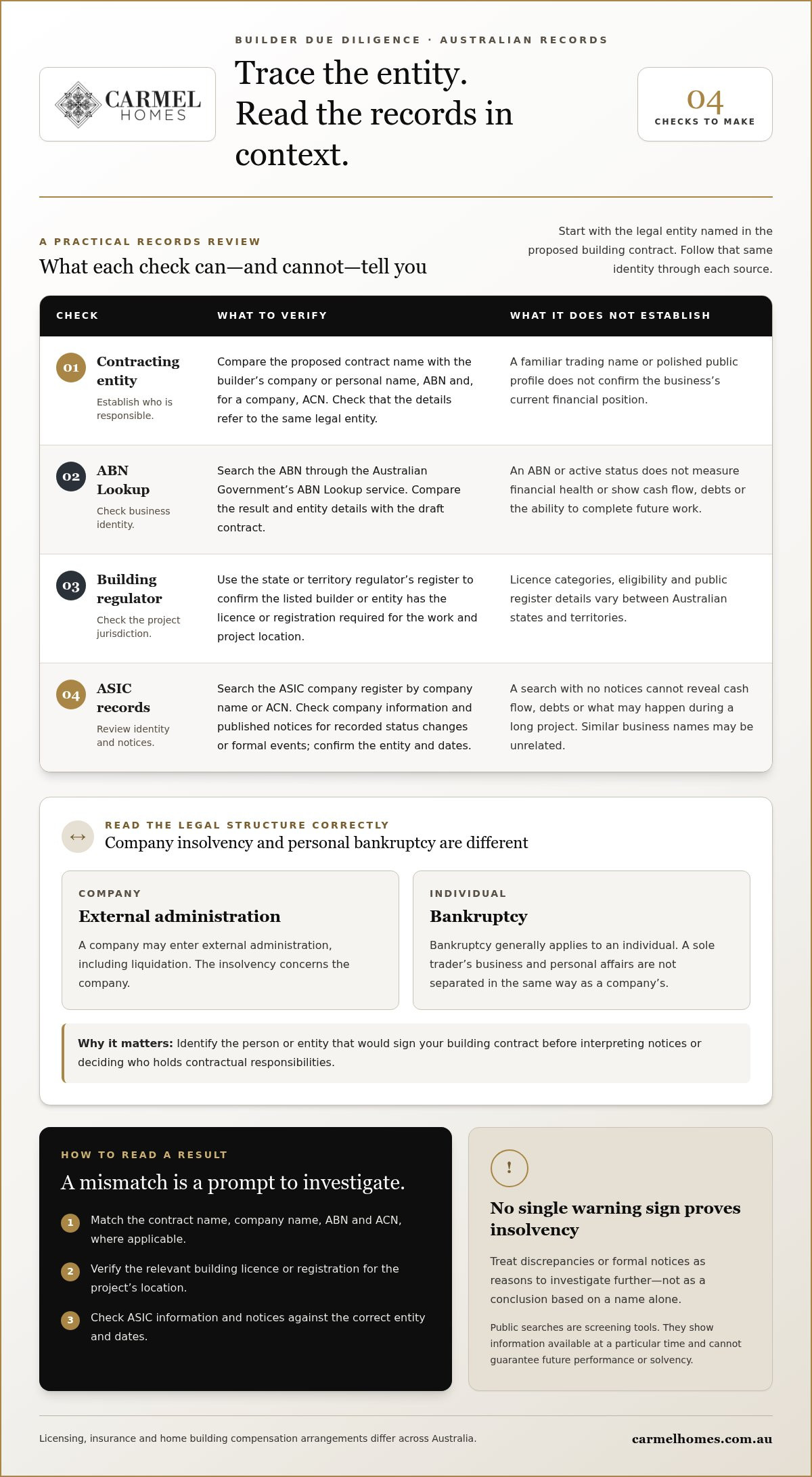
Start with a simple question: which legal entity will be responsible for your building contract? The trading name on a website may differ from the company or person signing the agreement. Follow the details through each check rather than relying on a familiar brand name. This is a practical first step in how to check if a builder is financially stable australia.
Confirm the legal entity and building credentials
Compare the proposed contracting entity’s name with its Australian Business Number (ABN) and, if it is a company, its Australian Company Number (ACN). Search the ABN through the Australian Government’s ABN Lookup service, then compare the result with the draft contract and the relevant state or territory building regulator’s register.
Check that the listed builder or entity has the licence or registration required for the work and the project’s location. Licence categories, eligibility and public register details vary across jurisdictions, so use the regulator responsible for the state or territory where the project will be built. If the contract names one entity but the licence or ABN search points to another, pause and clarify the difference before signing.
Search ASIC records and insolvency notices
Search the Australian Securities and Investments Commission (ASIC) company register using the company name or ACN. Company information can help confirm identity and reveal recorded status changes. ASIC’s published notices can also be searched for notices relating to external administration or other formal events. Check the named entity and dates carefully, as similarly named businesses may be unrelated.
ABN Lookup can help confirm business identity and details such as the entity’s status, but it does not measure financial health. A current ABN, active company registration or search with no notices does not reveal cash flow, debts or the ability to complete future work.
Match: Check that the contract name, company name, ABN and ACN, where applicable, refer to the same legal entity.
Verify: Confirm the relevant building licence or registration on the state or territory regulator’s register.
Review: Search ASIC company information and published notices, checking the entity and dates shown.
Interpret: Treat discrepancies or formal notices as reasons to investigate further, not as a conclusion based on a name alone.
Public searches are screening tools, not a guarantee of a builder’s future performance or solvency. Results reflect information available at a particular time, and a clean search cannot predict what may happen during a long project. For a further homeowner-focused due diligence checklist, see BUILTLY’s guide. Checking the builder’s identity is one part of a considered building relationship. You can also explore Carmel Homes’ bespoke design-and-build approach.
Which financial warning signs matter, and what can they tell you?
A warning sign is a reason to pause and seek context, not a diagnosis of insolvency. A project delay may have a practical explanation. Repeated unexplained delays alongside changing payment requests or inconsistent business details may justify closer scrutiny. This is central to how to check if a builder is financially stable australia: look for patterns and assess evidence together rather than drawing conclusions from one event.
Warning signs that deserve closer scrutiny
Pay attention to changes from what was agreed, particularly when explanations are unclear or records do not match. Reports that a company has entered external administration or liquidation require prompt attention, but confirm the exact legal entity and current status before acting. If you’re unsure how a record affects your contract or payments, seek qualified advice.
How to interpret records, reviews and reassurance
Official records and published notices are different from testimonials, promotional claims and online commentary. Check the entity named, the date and whether the information reflects a current status. An isolated complaint or rumour is not established evidence of insolvency. Likewise, an attractive display home, a long trading history or positive reviews do not demonstrate current financial strength.
No single positive or negative indicator settles the assessment. Reassurance is more meaningful when it aligns with verifiable records, clear explanations and reliable project communication. Treat each concern as a prompt for a proportionate follow-up check, not proof that a builder is financially distressed or an assurance that risk has passed.
What to check in the building contract, payments and home building compensation
Public-record checks help you understand who you’re dealing with; the contract sets out the commitments that govern the build. Reviewing both before signing is a practical part of how to check if a builder is financially stable australia. Clear terms can help you identify obligations and understand what to do if circumstances change.
Review contract and payment arrangements before committing
First, confirm that the contracting entity named in the agreement matches the company or person identified in your public-record checks. Read the documents as a connected set, including schedules, plans and specifications, so the scope of work is clear and consistent.
Scope and completion: Check that the agreed work, key inclusions, exclusions and completion obligations are described clearly.
Progress payments: Understand when each payment falls due and which stage or work it relates to. Payments should follow the contract and applicable legal requirements, which can vary by jurisdiction and circumstances.
Variations: Look for a process requiring changes to be documented in writing, including any effect on the scope, price or timing.
Disputes and delays: Note the steps the contract sets out for raising concerns, resolving disagreements and managing changes to the programme.
Resolve unclear wording before signing rather than relying on verbal assurances that may be difficult to interpret later. If a material term remains uncertain, independent legal or financial advice can help you understand the implications. A general guide cannot interpret the details of your particular contract.
Understand home building compensation protections in your jurisdiction
Home building compensation arrangements differ across Australian states and territories. The relevant scheme may set conditions around eligibility, project thresholds, the type of work covered and when cover must be in place. Before relying on a certificate or policy, verify current requirements, coverage details and any applicable limits with the regulator responsible for the project’s location.
Keep relevant insurance or compensation documents with your signed contract, and confirm that the details relate to the correct project and contracting entity. This protection may provide an important safeguard in defined circumstances, but it is not evidence that a builder is financially stable or a substitute for checking the business and contract carefully.
Clear documentation supports a more transparent relationship from design through construction. To learn about a bespoke design-and-build service, explore Carmel Homes’ design-and-build approach.
What happens if a builder becomes insolvent after work begins?
If you suspect a builder may be insolvent, take a measured approach. Your options depend on the contract, the project’s progress, the builder’s legal structure and the rules that apply in your state or territory. A company entering external administration, for example, raises different considerations from a sole trader experiencing financial difficulty.
Immediate steps for homeowners when insolvency is suspected
Start by preserving a clear record of the project and confirming what has happened. Keep the signed contract and schedules, payment records, correspondence, insurance or compensation certificates, and dated photographs showing the site and completed work. Save copies securely, including messages about delays, changed arrangements or payment requests.
Verify the contracting entity’s formal status through authoritative sources, such as ASIC notices and the relevant state or territory building regulator. Don’t rely on rumours or a social media post alone. Confirm that any notice relates to the correct business and is current.
Before stopping a payment, terminating the contract or arranging replacement work, seek prompt advice from a qualified legal professional. The contract and local requirements may affect your rights and obligations, so acting on assumptions could complicate the situation. Contact the relevant building regulator and, where applicable, the insurer or home building compensation scheme to understand the process that applies to your project.
How to make a more informed decision before your next build
For homeowners researching how to check if a builder is financially stable australia, a sound process brings several checks together: verify the contracting entity and its credentials, review official records, assess warning signs in context, and understand the contract and protections available in your jurisdiction. These steps can help you make a better-informed decision, although no pre-signing review can promise what a business’s circumstances will be in future.
Carmel Homes is a family-owned Australian custom home builder with over 30 years of experience. That history provides context about the business, but, as with any builder, longevity alone is not evidence of present financial stability. Its design-and-build service brings custom design and construction together under one project engagement, with project management guiding clients through each stage of the build.
If you’re considering a home shaped around your own vision, discover Carmel Homes’ bespoke design-and-build service.
Make your next building decision with confidence
A considered approach to how to check if a builder is financially stable australia brings several checks together. Confirm the legal entity and credentials, review current public records, and treat warning signs as prompts for further enquiries rather than proof of insolvency. Trading history, a polished presentation or positive reviews may offer context, but none verifies a builder’s present financial position.
Before committing, read the contract carefully, understand how payments and written variations are managed, and verify which home building compensation protections apply where the project will be built. If a concern arises during construction, preserve your records and seek qualified advice before changing payment arrangements or taking action under the contract. No check can remove every uncertainty, but clear information can help you make a more informed decision.
Carmel Homes is a family-owned Australian custom home builder with over 30 years of experience, managing bespoke design and build projects from concept to completion. Its history provides business context, not proof of current solvency. If you’re considering a home tailored to your vision, explore Carmel Homes’ bespoke design-and-build approach.
Frequently Asked Questions
How can I check whether a builder is financially stable in Australia?
Start by confirming the exact legal entity named in the proposed contract, then compare its company details, ABN and licence or registration information. Search ASIC records and the relevant state or territory building registers, and review published insolvency notices for the correct entity. Consider credible, documented concerns alongside these results rather than relying on rumours or reassurance alone. These checks help you assess risk, but they can’t guarantee future performance. Seek independent legal or financial advice if significant uncertainty remains.
What are the warning signs that a builder may be in financial trouble?
Repeated unexplained delays, sudden changes to payment arrangements, inconsistent company details or difficulty obtaining clear project updates may warrant closer attention. None proves insolvency on its own; there may be other explanations, and an isolated online review or rumour isn’t established evidence. Keep a written record of communications, compare payment requests with your contract, and check authoritative records. If concerns affect an active project or an upcoming payment, consider qualified advice before acting.
Can I check if a builder has entered liquidation or external administration?
Yes. Search ASIC company information and published notices using the builder’s correct legal name or company details. Check carefully that any result refers to the entity named in your contract, then note the dates and current status, as records can change. A search is a useful screening step, not a complete assessment of your project or rights. If you find a relevant notice, seek legal advice before deciding how to respond under your contract.
Does home building compensation insurance protect me if my builder goes bankrupt?
It may provide protection in defined circumstances, but the cover depends on your state or territory, the work, eligibility criteria, applicable thresholds, policy terms and circumstances of the builder’s failure. It isn’t a universal guarantee, and having cover doesn’t demonstrate that the builder is financially stable. Before relying on a certificate or policy, verify its details and current requirements with the responsible regulator or scheme administrator, including whether the cover relates to your particular project.
Is a builder with many years of experience financially stable?
Not necessarily. A long trading history can offer useful context, but it doesn’t confirm current cash flow, debts or capacity to complete a future project. Review the legal entity, current public records, contract terms and applicable protections together. Promotional claims, display homes and customer testimonials aren’t the same as independently verifiable financial information. Treat experience as one part of your understanding, not proof of present solvency or a substitute for current checks.
What should I do if my builder becomes insolvent during construction?
Preserve your signed contract, payment records, correspondence, insurance or compensation documents and dated photographs of the work. Confirm the contracting entity’s formal status through authoritative sources, then contact the relevant state or territory regulator and any applicable insurer or compensation scheme. Seek qualified legal advice promptly, as your next steps depend on the contract, project status, business structure and local rules. Don’t stop payments, terminate the agreement or arrange replacement work until you understand the implications.


