


Land Costs Are Quietly Crushing the Australian Home Dream
By Adib Adely
For decades, the "Australian Dream" has been synonymous with a quarter-acre block, a Hills Hoist in the backyard, and the keys to a brand-new home. But the reality on the ground is shifting. According to the latest data, that dream is increasingly being buried under the weight of skyrocketing land prices.
While public debate often fixates on the "cost of living" or the price of timber and steel, the real culprit behind our housing crisis is much more fundamental. It isn’t the house itself that’s breaking the bank; it’s the dirt it sits on.
The New Record Nobody Wanted to Break
If you feel like buying a home has become an Olympic-level feat of financial endurance, you aren’t imagining it. The national median price for residential land hit a record high of $391,420 in the September 2025 quarter. That is a 3.9% jump in just three months and a staggering 10.3% increase over the year.
To put that in perspective, land prices are currently growing at roughly three times the pace of consumer price inflation.
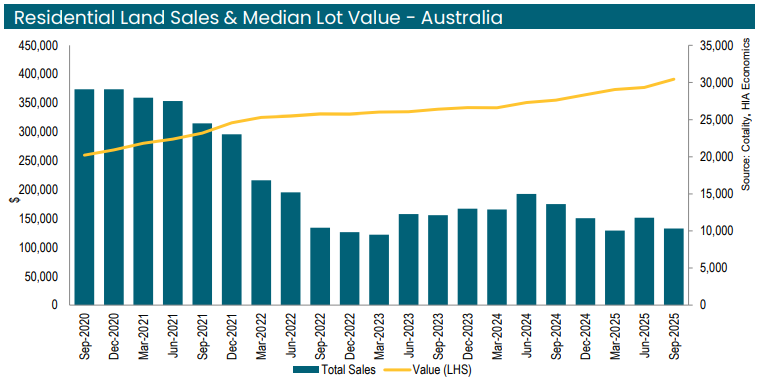
The data reveals a disturbing trend: prices are surging even as sales volumes drop. In any normal market, low demand should lead to lower prices. Instead, land supply has become the "binding constraint", there simply isn’t enough "shovel-ready" land available to meet demand, which keeps prices artificially high.
A Tale of Two Australias: Capitals vs. Regions
The pain isn't distributed equally. If you’re looking to buy in a capital city, the median price of a lot surged 6.1% in the latest quarter to $437,855, up 12.8% year-on-year.
The City Breakdown:
Greater Sydney: Still the heavyweight champion of unaffordability with a median lot price of $685,000.
Greater Brisbane: Prices have nearly doubled in the last decade, with most of those gains occurring in just the last four years. The median now sits at $452,250.
Greater Adelaide: The "dark horse" of the quarter, Adelaide saw land prices jump nearly 40% in a single year.
Greater Perth: After decades of stability, Perth is hitting new highs as it runs into its own binding land constraints.

Regional Australia offers some relief, but even there, the "bargains" are disappearing. Regional lot prices grew to a median of $295,160. However, elite regional pockets like the Gold Coast ($751,000) and the Mornington Peninsula ($700,000) are now more expensive than most capital cities.
Why "The Cost of Building" is a Myth
We often hear that rising wages for tradies or the cost of materials are to blame for expensive homes. The long-term data suggests otherwise.
Since the year 2000, residential land prices have increased by over 500%. During that same 25-year window, construction costs rose by approximately 150%.

Even when you account for "regulatory creep", the added costs of shifting to seven-star energy efficiency standards, the increase in the value of building approvals was 273.4%. That is still barely half the growth rate of land. The largest and most persistent contributor to housing costs isn't the physical act of building; it’s the policies that shape the price of the lot.
Making Water Flow Uphill: The Policy Problem
If there is plenty of dirt in Australia, why is the land so expensive? The HIA report uses a vivid metaphor: "making water flow uphill".
Land price isn't just about the "dirt". It reflects the cost of making that dirt ready for housing, rezoning, roads, water, sewerage, and electricity.
Historically, this infrastructure was funded by general government revenue. Today, these costs are loaded onto the new homebuyer through developer contributions, infrastructure levies, and utility connection fees. These charges often go well beyond the efficient cost of the infrastructure itself. By the time a family buys a lot, they are essentially paying a hidden, upfront tax for community facilities.
Shrinking Lots, Growing Prices
For the better part of a decade, the trend for the Australian backyard has been a "death spiral." Since 2015, almost every major city has seen its median lot size shrivel as developers carved land into smaller and smaller slices to keep prices down.
However, the latest data shows a strange, recent "bounce": median lot sizes in capital cities actually rose to 410 square metres this quarter.
Don’t be fooled, this isn’t a win for buyers or a return to the "quarter-acre block." It is actually a symptom of a massive supply crisis. Because there is effectively zero shovel-ready land left to sell in inner and middle-ring suburbs (where lots are tiny), the only sales actually happening are on the far-flung fringes of our cities, where blocks are naturally a bit larger. This "compositional shift" skews the average upward, making it look like lots are growing when, in reality, the smaller, more central options have simply vanished.
The City Breakdown:
The Massive 10yr Decline: If you compare the 2015 bars to the 2025 bars on the graph, the long-term reality is clear: Sydney, Melbourne, and Perth have all shrunk significantly over the decade.
Brisbane is the lone survivor: It is the only capital city where lots are genuinely larger now (506 sqm) than they were ten years ago.
Adelaide is the "Truth-Teller": While other cities have their data skewed by those large outer-fringe sales, Adelaide is the only capital where the mask has slipped. It is the only city where lots are still aggressively shrinking in both the short and long term, hitting a record low of just 348 square metres.
The result is a double-hit for families. In cities like Adelaide, you are paying more for less land than ever before. And in cities like Sydney or Melbourne, you might get a "larger" lot on paper, but only because the market has forced you so far out of the city that you’ve lost the choice of anything else.

The Bottom Line
The scarcity of land in our cities is largely artificial. It is a market failure manufactured by planning systems and infrastructure models that ration supply and load costs onto the next generation of homeowners.
We can argue about interest rates and timber prices, but those are distractions. Until governments address the way land is supplied and serviced, the "Australian Dream" will remain a luxury item. If we want to fix housing, we have to start by fixing the dirt


