


Luxury custom home builders: How to choose a considered design-and-build partner
A striking portfolio doesn’t always reveal how a builder will interpret your brief or carry its details through to construction. Finished photographs show the result, but rarely the decisions behind it. Choosing among luxury custom home builders means looking beyond appearances to assess design judgement, communication and how the project will be managed.
It’s natural to want a home that feels unmistakably yours, and confidence that its important details will remain clear as ideas become plans and plans become a home. This guide offers a practical framework for comparing a shortlist, assessing design capability alongside project management, and deciding which partner fits your priorities. Carmel Homes is a family-owned luxury custom home builder with more than 30 years of experience, guiding bespoke projects from concept through construction and after-care. The sections below explain what to look for as you move from early ideas towards a home shaped around the way you want to live.
Table of Contents
What luxury custom home builders do beyond constructing a house
How to assess a luxury custom home builder’s design capability
How to compare luxury custom home builders beyond their portfolios
What to clarify before choosing a luxury custom home builder
How Carmel Homes brings a bespoke home from concept to completion
What luxury custom home builders do beyond constructing a house
A considered home starts with more than a floor plan or a selection of finishes. Luxury custom home builders interpret an individual brief and translate it into a design suited to the household, the site and the way the home will be used. Their work links design decisions with project delivery, helping carry the original intent from concept into construction.
That connection matters because design quality is not measured by appearance alone. A home may be striking yet fall short if its rooms don’t support daily routines, its layout doesn’t respond to the site, or important details remain unresolved. A thoughtful design considers how spaces relate, where natural light falls, how people move through the home and which materials will give it character. When choosing a builder, weigh this design sensibility alongside their ability to manage the work that brings the design to life.
How bespoke building differs from selecting a standard plan
In a tailored design-and-build engagement, personal priorities inform the layout, architectural character and practical decisions from the outset. A family’s need for quiet study areas, connected living spaces or separation between private and shared zones can shape the plan, rather than being fitted around a predetermined arrangement. Customisation is purposeful design, not simply the addition of decorative finishes.
For a broader comparison of tailored and volume approaches, see our guide to custom versus volume builders. The distinction is also reflected in the idea of commissioning a bespoke home: the homeowner shapes an individual project without necessarily undertaking the physical work themselves.
What luxury means in a well-considered home
Luxury is not a measure of excess. It is the fit between craftsmanship, material choices and the life a home is intended to support. Natural light, well-planned storage, durable surfaces and well-proportioned rooms can matter as much as a distinctive façade, especially when they make daily living more comfortable and intuitive.
Long-term needs deserve equal attention. A flexible room may serve as a study today and adapt as the household changes; clear circulation can make shared spaces work more gracefully. These choices give architectural quality a practical dimension and help a home remain relevant beyond its first impression.
Bespoke design means shaping a home around a specific brief and site, then delivering it with care. Carmel Homes’ custom design-and-build service manages projects from concept through construction and after-care. As a family-owned builder with more than 30 years of experience, Carmel Homes brings attentive design and full-service project management together, keeping the relationship between the vision and its realisation in view.
How to assess a luxury custom home builder’s design capability
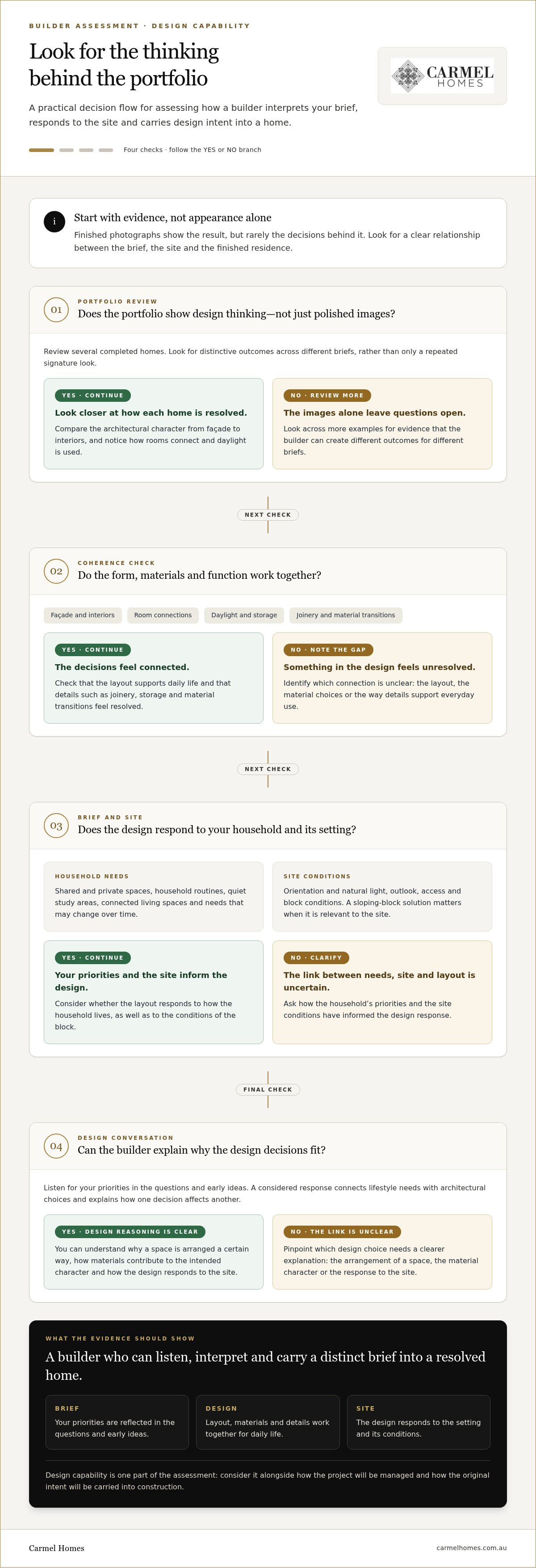
A portfolio can be visually compelling without showing how thoughtfully a home was conceived. To assess design capability, look for a clear relationship between the brief, the site and the finished residence. Strong work feels coherent: the exterior character, internal planning, material palette and everyday function belong together, rather than appearing as unrelated decisions.
Read a portfolio for design thinking, not just visual appeal
As you review completed homes, consider whether the architectural character carries through from façade to interiors. Notice how rooms connect, how daylight is used, and whether details such as joinery, transitions between materials and storage feel resolved. Look at several examples, too. A portfolio can provide inspiration, but evidence of bespoke capability lies in a builder’s ability to create distinctive outcomes for different briefs, not simply repeat a signature look.
Use a few practical questions to guide your review:
Does the layout support daily life? Look for clear routes between rooms and spaces that suit the household’s routines.
Do form and materials work together? A restrained palette, for example, should feel intentional across the exterior and interior.
Does the design respond to its setting? Consider whether orientation, outlook, access or block conditions appear to have informed the result.
Test how a builder interprets your brief and site
Before discussing design, sort your priorities into essentials and preferences. Think about how you use shared and private spaces, which routines the home should support, and what may change over time. Then consider what the site may mean for the design. Orientation can influence how rooms relate to natural light, while access and block conditions can affect the layout. Sloping-block solutions are an example of a capability that may matter for a particular site, rather than a style choice in isolation.
In a design conversation, listen for whether your priorities are reflected in the questions and early ideas. A considered response connects lifestyle needs with architectural choices and explains how one decision affects another. You don’t need specialist terminology to judge the fit. You should be able to understand why a space is arranged in a particular way, how materials contribute to the intended character, and how the design responds to the site.
The strongest portfolio is not necessarily the one with the most dramatic images. Look for evidence that a builder can listen, interpret and carry a distinct brief into a resolved home. Read more about Carmel Homes’ bespoke design-and-build approach and how design and delivery come together.
How to compare luxury custom home builders beyond their portfolios
A portfolio shows what a builder has created, but not how decisions were made, responsibilities managed or questions handled along the way. Comparing luxury custom home builders calls for a broader view of the working relationship, especially when a bespoke brief needs to be defined before construction begins.
Use a simple framework to compare proposed engagements. For each one, note what is explained clearly, what needs clarification and how closely the approach aligns with your priorities.
What evidence reveals a builder’s approach to project delivery?
Look for a clear explanation of who guides each stage, from design development through construction and after-care. The process should set out how decisions are raised, who communicates with you and when your input is needed. This doesn’t require elaborate promises; it requires an understandable account of how the work is organised. For a closer look at project delivery, read the article on full-service project management.
How to compare scope, inclusions and expectations
Bespoke work can be difficult to compare when proposals rely on broad descriptions. Read the written scope and specified inclusions closely, checking that they reflect the design being discussed. Look for clear explanations of how design development proceeds, how changes are recorded and how client decisions are incorporated. If an important element is described differently across proposals, record the difference rather than assuming the wording means the same thing.
Take time to understand the agreement before proceeding. Check that the terms and responsibilities are clear to you, and seek appropriate independent advice if you need help interpreting contractual language. Clarity is an important part of a considered decision.
Detailed cost questions are covered in the dedicated cost-expectations article. Here, focus on whether the proposed scope gives you a clear basis for understanding what the engagement covers and how the work will be managed. A well-documented process gives both parties a shared reference as the project advances and helps keep the design intent in view.
What to clarify before choosing a luxury custom home builder
A clear brief and careful review of the proposed engagement make it easier to compare design-and-build partners on more than first impressions. You don’t need every detail decided before you begin. Identify what your household needs most, then note which preferences can be refined as the design develops.
Prepare a useful brief before your first design conversation
Describe how you want the home to support everyday life. A short list can help organise your thoughts:
Household routines: Consider how you use shared spaces, where you need privacy and whether work, study or entertaining should be accommodated.
Spatial priorities: Note essential relationships between rooms, storage needs and any areas that require flexibility.
Aesthetic references: Gather images, materials or architectural details that express the character you’re drawn to, while remaining open to how they could be interpreted for your home.
Long-term considerations: Identify needs that may change over time, such as adaptable spaces or different household arrangements.
Separate non-negotiables from preferences. A particular relationship between rooms might be essential, while a colour or finish could remain open to discussion. This helps the builder understand the purpose behind your choices, rather than treating every reference as a fixed instruction.
Bring together relevant information about the site, including what you know about access, orientation or block conditions. Record known constraints, but avoid drawing technical conclusions before they’re properly assessed. Most importantly, describe how you want the home to feel in daily life: calm and private, open and connected, or suited to gathering with family and friends. That gives the design conversation a meaningful starting point.
Review the proposed engagement with care
Read the proposal and related documents at a considered pace. Check that responsibilities for design, construction, project oversight and after-care are understandable, and that you can see how the engagement carries the brief from concept into delivery. Carmel Homes’ connected design-and-build approach brings these stages together, with full-service project management supporting the process.
Review how the written scope describes inclusions, decision points, communication, design changes and the approvals or input expected from you. Clear documentation gives everyone a shared reference and can reduce uncertainty, though it can’t remove every decision or change that may arise during a bespoke project. Take time to understand the contractual terms, and seek independent advice if you need help interpreting them.
Once your priorities are taking shape, you can discuss your custom home vision with Carmel Homes.
How Carmel Homes brings a bespoke home from concept to completion
After considering design fit, scope and project oversight, the next step is finding a partner who can carry your priorities into the finished home. Carmel Homes brings these elements together through a bespoke design-and-build engagement, with project management connecting the design intent to construction and after-care. As a family-owned business with more than 30 years of experience, Carmel Homes offers a considered approach to a substantial personal investment.
A design-and-build relationship shaped around the client’s brief
The process starts with your aspirations and project requirements. Household routines, preferred architectural character, the site and the spaces you value most all help inform a design tailored to your brief, rather than a standardised plan with personal touches added later. As the design develops, the aim is to keep those priorities connected to the decisions that shape the home.
Design and construction sit within one connected engagement, supported by full-service project management. This helps maintain continuity as a considered design moves from concept into construction, with after-care also part of the service. The project type shapes the brief: a custom home, knockdown rebuild , dual occupancy or sloping-block solution each has its own requirements.
This connection means the conversation can cover both the character you want to create and the practical considerations involved in bringing it to life. Carmel Homes’ experience informs the process, while your individual brief remains central. The aim is not to prescribe a single expression of luxury, but to guide a home that reflects the people who will live in it.
A considered next step for your custom home project
You don’t need every selection or design detail resolved before beginning a conversation. A clear sense of what matters most is a useful starting point. Consider how you hope the home will feel, which spaces are essential to daily life, what you know about the site and what you want the project to achieve over time. These priorities help establish a direction for a bespoke design-and-build discussion.
Among luxury custom home builders, the right partner is one whose design approach and project delivery align with your ambitions. Carmel Homes brings more than 30 years of family-owned experience to that relationship, guiding bespoke projects from concept through construction and after-care. Explore what a tailored home could become through a custom design-and-build conversation with Carmel Homes.
Choose a partner who can carry your vision forward
The right choice among luxury custom home builders rests on more than a compelling portfolio. Look for design that responds to your household and site, a written scope that makes responsibilities understandable, and project management that connects the journey from concept into construction. Clarifying your essential needs and the preferences that can evolve will also help make the design conversation more purposeful.
Carmel Homes is a family-owned luxury custom home builder with more than 30 years of experience. Its bespoke design-and-build service brings design, construction and after-care together, with full-service project management supporting the process. The aim is to guide your individual brief into a home shaped around the way you want to live.
To explore what that could mean for your project, discuss your custom home vision with Carmel Homes. A considered beginning can help turn your aspirations into a home with lasting meaning.
Frequently Asked Questions
What does a luxury custom home builder do?
A luxury custom home builder works with you to shape a residence around your brief, lifestyle and design preferences, then manages its construction. A design-and-build engagement can bring design, building and project oversight together rather than starting with a standard plan. Review the written proposal to understand the services, responsibilities and deliverables, including how the design will be carried through into construction.
How do I choose between luxury custom home builders?
Compare how each builder responds to your brief, not just how polished their portfolio looks. Consider whether the design approach suits your household and site, and whether the proposed scope, communication and project oversight are clearly explained. For example, compare how each proposal addresses a priority such as connected living areas or private workspaces. The right fit should align with your needs and make the working relationship understandable from the outset.
Can a custom home builder design a home around my block?
Yes, a bespoke design can respond to your block’s characteristics as well as your household’s needs. Orientation, access, slope and other site conditions may influence the layout and design choices, depending on the property. Share the site information you have during early discussions, and note known constraints without assuming their technical implications. Reviewing examples of different site responses can help you understand how a builder adapts its design approach.
What should a custom home building agreement explain?
A custom home building agreement should clearly describe the project scope, design and construction responsibilities, specified inclusions, decision points and the process for managing changes. It should also explain communication and project-management arrangements, so you can understand how the work will progress and where your input is needed. Read the terms carefully rather than relying on broad assurances. If you need help interpreting contractual obligations, seek independent advice before making a decision.
How long does it take to build a luxury custom home?
The timeframe for a luxury custom home varies according to its design, site conditions, approvals, project scope, material selections and construction requirements. Because these factors differ between projects, a single timeframe won’t accurately represent every bespoke build. Review the proposed programme, its key stages and the factors that could affect timing. When comparing estimates, check that the scope and assumptions are equivalent before drawing conclusions.
Is a design-and-build service right for a luxury custom home?
A design-and-build service may suit you if you value a connected relationship between the home’s design vision and its construction. It can bring design, building and project oversight together, while still requiring clear decisions and communication throughout the project. Consider whether the written scope and working approach match your priorities. Carmel Homes provides bespoke design and build from concept through construction and after-care, with full-service project management as part of its offering.


