


Common Pitfalls in Building Contracts: What Australian Homeowners Should Know
What if the most important decisions about your custom home are the ones the contract leaves unclear? Beautiful plans can express a distinctive vision, yet uncertainty around drawings, specifications or inclusions may affect what is ultimately built. The common pitfalls in building contracts often begin before construction, when the written scope, responsibilities and process for changes don’t fully align with the design. It’s understandable to want confidence in both the home and the financial commitment before signing.
This guide explains what to review before committing to a custom build, how fixed-price and cost-plus arrangements differ, and why allowances, provisional sums, variations, delays, payment stages and dispute processes deserve careful attention. It will also help you consider how the contract structure shapes responsibility and project certainty, with state and territory requirements forming part of the wider picture. For a bespoke design-and-build engagement, continuity between design, construction and project management can be an important consideration. With more than 30 years of experience, Carmel Homes approaches each home as an integrated project, guiding clients from initial design decisions through construction and after-care.
Table of Contents
Why common pitfalls in building contracts begin before work starts
Common building contract pitfalls in scope, allowances and changes
Fixed-price versus cost-plus building contracts: what changes for homeowners?
A practical pre-signing checklist for an Australian building contract
How an integrated design-and-build approach can support contract clarity
Why common pitfalls in building contracts begin before work starts
Signing a building contract is a significant commitment. It gives written form to a home that may represent years of planning, personal decisions and substantial investment. The contract sets out the agreed scope, each party’s responsibilities, payment arrangements and how the project will be administered. It should give the design a clear path from intention to construction, rather than leave important decisions open to interpretation.
Some of the common pitfalls in building contracts take shape before work begins, when the agreement describes a different project from the one the homeowner believes they have commissioned. A drawing may show a feature that the written scope does not address, or a selection may still be awaiting confirmation. These gaps can create competing expectations, even when both parties began with the same vision.
What a building contract needs to make clear
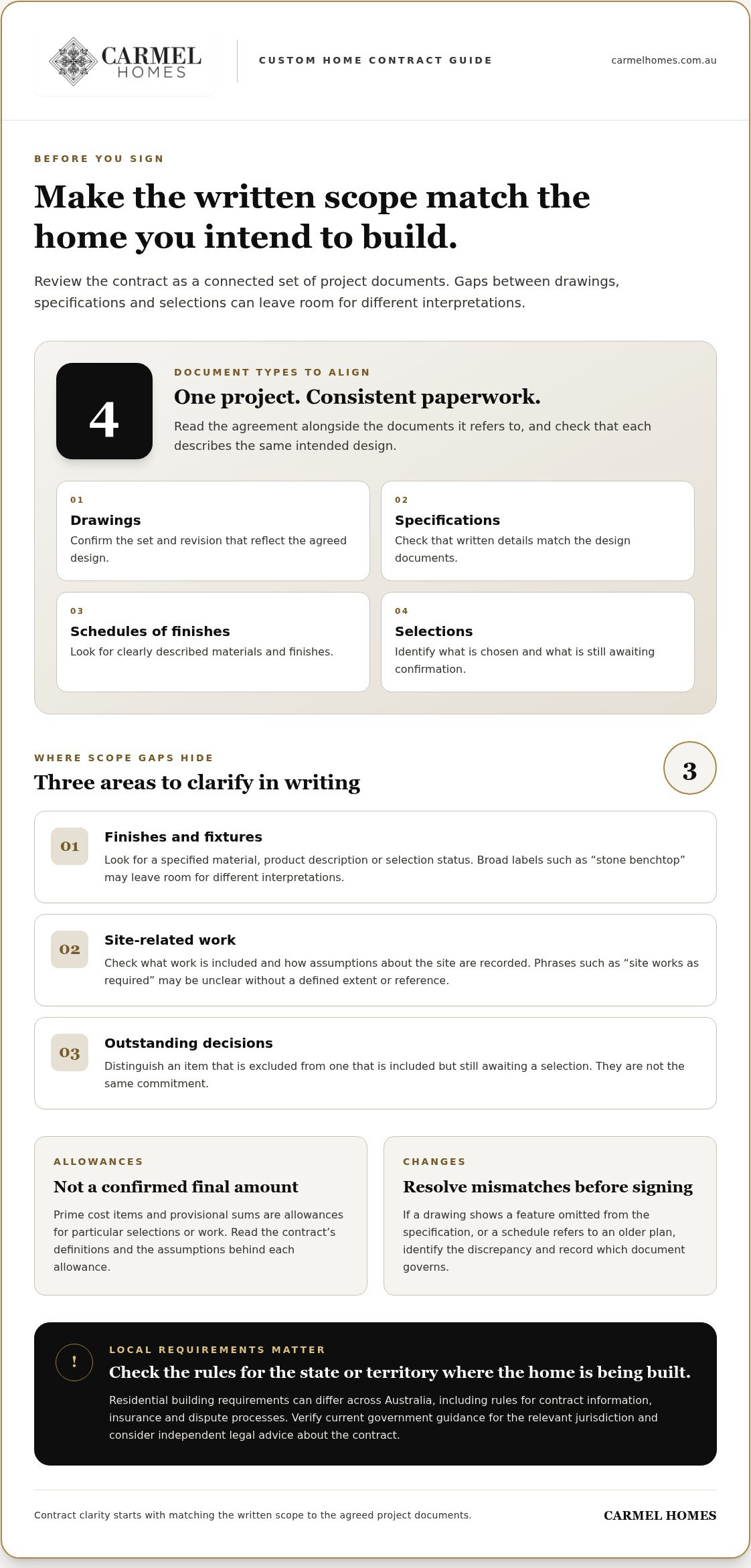
Read the contract alongside every document it refers to, including drawings, specifications, schedules of finishes and selections. Check that document titles, dates and revisions identify the version that reflects the intended design. A general reference to “plans” may not resolve which set applies if several versions have circulated during design development.
The written agreement should distinguish between work that is included, work that is excluded and decisions that remain outstanding. If a finish has not been selected, for example, the documents should explain how that choice will be recorded and managed. Don’t rely on an informal assumption to fill the gap. The contract should also explain who is responsible for decisions, approvals and project communications, and how those matters are documented. Contract clarity depends on matching the written scope to the agreed project documents. This is a useful principle in any construction contract, although a general overview does not replace Australian jurisdiction-specific guidance.
Why Australian contract requirements can differ
Residential building requirements are not identical across Australia. State and territory laws may set different rules for domestic building contracts, required information, insurance and dispute processes, and requirements can change over time. The applicable framework may depend on where the home is being built and the nature of the work, so advice drawn from another jurisdiction may not suit your project.
The Australian Consumer Law may be relevant to consumer transactions and associated rights, but its application to a particular building contract or term depends on the circumstances and how it interacts with other applicable laws. A general summary cannot answer every question about your agreement. Before signing, verify current requirements through the appropriate government guidance for the relevant state or territory, and consider obtaining independent legal advice about the contract. This helps put the documents in their proper local context before construction turns an unresolved detail into a practical concern.
Common building contract pitfalls in scope, allowances and changes
For a bespoke home, a small gap in the paperwork can have a larger consequence: two people may picture the same room differently, or understand a cost allowance as a confirmed inclusion. These common pitfalls in building contracts are easier to identify when you review the agreement as a set of connected documents, rather than relying on a headline description of the build.
Scope gaps and incomplete project documents
Compare the contract’s document list with the latest drawings, specifications, schedules and selections. Check that the versions are identified consistently and that each document describes the same design. Phrases such as “quality fittings” or “site works as required” may leave room for different interpretations unless the relevant standard, extent or reference is made clear.
Pay particular attention to details that shape both the appearance and practical delivery of the home:
Finishes and fixtures: identify the specified material, product description or selection status, rather than relying on a broad label such as “stone benchtop”.
Site-related work: look for a clear description of the work included and how any assumptions about the site are recorded.
Outstanding decisions: distinguish an item expressly excluded from one that is included but still awaits a selection. They are not the same commitment.
If a drawing shows a feature that the written specification omits, or a schedule refers to a superseded plan, note the discrepancy before signing. Resolve which document governs and ensure the agreed version is accurately recorded. This comparison can reveal whether the contract describes the home you intend to build, rather than a similar but different interpretation.
Allowances, variations and written approvals
Prime cost items and provisional sums are commonly used to describe allowances for particular selections or work, but terminology and requirements can differ between jurisdictions and contract forms. Read the contract’s definitions and the assumptions behind each allowance. Check what item or work it covers and how any difference from the allowance is treated. An allowance is an estimate for a defined item or work, not a final outcome.
Consider a bathroom fixture allowance: until the chosen fixture and its relevant costs are established under the contract, don’t treat the allowance as a settled final amount. Likewise, a provisional sum for defined work may depend on assumptions set out in the documents. Understand those assumptions before relying on the figure as a complete description of the commitment.
Design choices may evolve, but an undocumented change can leave uncertainty about what was approved, its effect on the contract price or timing, and which plans now apply. Review the variation process to see how a proposed change is described, priced, submitted for approval and recorded, and whether timing implications are documented. Keep the written approval with the project documents. A clear record supports communication, although it cannot promise to prevent every disagreement.
Official guidance on resolving building disputes provides an example of a jurisdiction-specific pathway to consider if a disagreement arises. For a custom home, a connected design-and-build engagement can also help maintain continuity between design decisions and construction management. Read guidance on resolving building disputes. Carmel Homes’ custom design and build approach brings design and construction stages together, while clear written terms remain essential.
Fixed-price versus cost-plus building contracts: what changes for homeowners?
The contract’s pricing structure affects how costs are calculated and where uncertainty may sit, but the name alone cannot tell you what the final commitment will be. For a custom home, compare the structure with the scope, allowances, exclusions and change process set out in the documents. This helps you assess not only the proposed price, but also how decisions during the build may affect it.
Price basisFixed-price: The contract sets a price for the defined scope, subject to its terms and any stated exceptions.Cost-plus: The homeowner pays defined project costs, together with an agreed fee or margin, as set out in the contract.
Scope changesFixed-price: Changes to the agreed work may affect the price or other terms under the variation provisions.Cost-plus: Changes may alter the actual costs charged, with the contract determining how they are proposed, approved and recorded.
UncertaintyFixed-price: The price may be more predictable for the scope covered, while exclusions, allowances and changes can still affect the final amount.Cost-plus: The final amount can remain less certain because it depends on chargeable costs and the agreed fee or margin.
Contract structure influences risk allocation, while the actual terms determine how it works. Neither arrangement guarantees a particular final cost or removes every project risk. Site conditions, unresolved selections, design changes and the contract’s treatment of those matters all shape the homeowner’s financial exposure. This is a general comparison, not a substitute for reading the specific agreement or checking applicable state or territory requirements.
How a fixed-price arrangement may frame the commitment
A fixed-price arrangement generally links an agreed price to a defined scope of work. Its usefulness depends on how fully that scope is documented. If drawings or specifications leave important elements open, the price may not represent every detail the homeowner expects. Read exclusions and allowances closely, and understand how the contract treats changes, including any adjustment to price or timing. A fixed price does not mean every later decision or unforeseen circumstance is automatically absorbed into the original amount.
How a cost-plus arrangement may frame project costs
A cost-plus arrangement broadly calculates payment from project costs defined by the contract, plus an agreed fee or margin. Clarity rests on knowing which costs are chargeable, how they are evidenced and when the homeowner receives cost information. Review the process for approving expenditure and proposed scope changes, and how the fee or margin is calculated. Without clear definitions and reliable records, it can be harder to track the developing total.
Suitability depends on the project, the quality of its documentation and your comfort with cost uncertainty. A carefully specified design and a clear process for decisions can support a more informed comparison, whether the arrangement is fixed-price or cost-plus. Focus on the written obligations and how they relate to the home you intend to build, rather than assuming one label is inherently safer.
A practical pre-signing checklist for an Australian building contract
Before signing, review the contract as a complete project record, not simply a price and a signature page. A step-by-step check can help reveal missing information while there is still an opportunity to clarify it. Use this sequence as a practical starting point for assessing a bespoke home-building agreement.
Gather every contract document. Assemble the agreement, schedules, drawings, specifications and referenced selections. Check that each document is identifiable by title, date or revision, and that the set is complete. Keep a copy of the final signed documents and any records incorporated into the agreement.
Match the documents to the intended home. Compare the referenced plans and specifications with the design you intend to build. Confirm that key layouts, finishes, fixtures and project details are represented consistently, and note any missing schedules or conflicting descriptions for resolution before signing.
Read the scope and responsibilities together. Identify what work is included, what is excluded and which decisions remain outstanding. Understand who manages selections, approvals and day-to-day communications, how instructions are recorded, and how project records will be shared and retained.
Understand the money provisions. Review the contract price or pricing method, allowances, deposit arrangements and payment schedule. For each progress claim, check what stage or work triggers payment and how the amount is calculated or supported under the agreement. Make sure the payment sequence is clear to you.
Review changes and timing. Locate the variation procedure and see how a proposed change is described, approved and recorded, including any stated effect on price or timing. Read the provisions for start dates, extensions of time and delays, and understand how handover and any defects process are documented.
Consider dispute and termination processes. Read how the agreement says concerns or disagreements are raised and handled, and what steps apply if either party seeks to end the contract. Understand these terms in the context of the project’s location and applicable requirements.
Review the documents and responsibilities together
Don’t treat a missing schedule or inconsistent detail as a minor administrative matter. If a selection, drawing or responsibility is unclear, record the point and seek written clarification before signing. A complete set of aligned documents gives both parties a more dependable reference as the design moves into construction, while clear communication responsibilities help keep decisions traceable.
Understand payment, timing and dispute provisions
Progress claims, delay provisions, handover, defects, dispute steps and termination terms should be read as connected parts of the agreement. Their wording and legal context can vary, as residential building requirements differ between Australian states and territories. Verify current obligations for the jurisdiction where the project will be built, and consider independent legal advice if a term is unclear.
Taking time to complete this review can make the next conversation about your home more considered and precise. Carmel Homes’ custom design-and-build process brings bespoke design, construction and project management together as a connected engagement.
How an integrated design-and-build approach can support contract clarity
A bespoke home takes shape through many connected decisions, from the first design conversations to the materials and details that give each space its character. When design and construction sit within one project engagement, continuity can help keep those decisions in view as the home moves from concept towards the building site. It can also make it easier to discuss how the intended design is represented in the contract documents.
Integration is not a substitute for a clear written agreement, nor does it remove construction risks. The contract and referenced documents still need to set out the agreed scope, responsibilities, pricing arrangements and processes for changes. Design continuity and considered project management can support informed conversations about whether the written agreement reflects the home being planned.
Connecting bespoke design with the construction agreement
As a design develops, details may be refined: a window’s position, a room’s proportions or the finish selected for a particular surface. Those decisions need to be reflected consistently in the project documents that describe the work. If the design evolves but the supporting drawings or specifications do not, the parties may be working from different understandings of the intended result.
Continuity from concept through construction can help keep design intent and practical delivery in the same conversation. It gives the project team and homeowner a context for considering how a design decision relates to the documented scope, and whether revised information needs to be recorded. That context can bring common pitfalls in building contracts into view, but clarity still depends on the actual written terms and the documents they refer to.
Considering your next step with Carmel Homes
Carmel Homes is a family-owned Australian custom home builder with more than 30 years of experience. Its design-and-build engagement spans bespoke design, construction and after-care, with full-service project management guiding clients through the stages of a build. For homeowners shaping a highly individual home, this connected process carries design conversations into construction management and beyond, while keeping the contract central to understanding the agreed work.
As you consider your priorities, note the design decisions, communication and project guidance that matter most to you. These priorities can inform a bespoke design-and-build engagement and help focus your discussions around the home you want to create.
Shape your next decision with confidence
A considered building journey begins with more than a signature. It begins with a clear sense of the home you want to create, the decisions that matter most to you and the level of guidance you value as the project progresses. Keeping those priorities in view can help you approach contract discussions with greater confidence and recognise the common pitfalls in building contracts before they cloud your understanding of the commitment.
As you move from research towards a bespoke project, consider how your design aspirations can be translated into a coordinated process. Discuss your bespoke home project with Carmel Homes to explore how your vision could take shape through design, construction and project management.
Frequently Asked Questions
What are the most common pitfalls in building contracts?
Common pitfalls in building contracts include vague descriptions of the work, mismatched design documents, unclear allowances and poorly documented changes. Problems can also arise when payment stages, delay procedures or responsibility for decisions are difficult to understand. For example, a schedule that names a finish without identifying the selection can leave uncertainty about what was agreed. Look for gaps between the contract’s wording and the project information, and have unclear points addressed in writing before signing.
What should I check before signing a building contract in Australia?
Check that the contract identifies the parties and the project, and that its schedules and referenced documents are complete and current. Pay particular attention to how the agreement handles deposits, progress claims, variations, delays, insurance, defects, disputes and termination. Confirm that the names and details in the contract are accurate, and keep a complete copy of the signed agreement and its attachments. Requirements differ across states and territories, so verify current rules for the project’s location.
Is a fixed-price building contract always the safer option?
No, a fixed-price label alone doesn’t establish that the arrangement is safer or that the final amount cannot change. The degree of certainty depends on the defined work, exclusions, allowances and the terms for variations or other adjustments. For instance, a contract may state a price while leaving some selections unresolved. Consider how comfortable you are with that uncertainty, then compare the written pricing provisions with the design and scope they cover.
What is the difference between a prime cost item and a provisional sum?
A prime cost item generally refers to an allowance for a particular item to be selected or supplied, while a provisional sum generally relates to an allowance for defined work whose final cost may not yet be established. The contract should explain the basis of each allowance and how any difference is treated. Terminology and requirements can vary between contract forms and jurisdictions, so rely on the agreement’s definitions rather than assuming the labels mean the same thing everywhere.
Can a builder change the contract price after it is signed?
A signed contract doesn’t mean the price can be changed arbitrarily, but the amount payable may be adjusted in circumstances set out in the contract or relevant law. These may include an approved variation or the way an allowance is reconciled, depending on the agreement and jurisdiction. If you receive a proposed adjustment, compare it with the relevant contract provision and written records, and seek independent advice if you’re unsure whether it has been properly raised.
Does a building contract need to include plans and specifications?
The contract should identify the plans and specifications that form part of the agreement, whether they are physically attached or incorporated by reference. These documents provide a shared point of reference for the design and work being undertaken. Check that the contract identifies the correct revisions, especially if plans have changed during design discussions. If a document is missing or the referenced version doesn’t reflect the intended home, request clarification before relying on the agreement.
What happens if my building contract does not clearly explain delays?
If delay provisions are unclear, it may be difficult to understand how the contract treats notice, extensions of time or revised completion expectations. Keep dated written records of relevant communications and events, and refer to the agreement’s notice and dispute procedures. Don’t assume that a delay automatically creates a particular right or remedy, as the answer can depend on the contract and applicable state or territory requirements. Consider getting independent legal advice about your circumstances.


