


Progress Payments for a New Home Build in Australia: How They Work
What if a builder’s progress claim arrives before your lender is ready to release the funds? If you’re researching progress payments new home build australia, it helps to understand that a contract claim and a lender drawdown are connected, but they’re separate steps. The claim relates to a construction milestone under your building contract. The drawdown is the lender’s release of loan funds after any required checks.
The gap between those steps can feel uncertain, especially if a variation or a change to the construction schedule affects your cash flow. Preparing before construction starts can make the process easier to manage. This guide explains how contract milestones, claims and construction loan drawdowns fit together, and what to track as the build progresses.
You’ll learn what documents and assessments may be involved, why the contract schedule and lender requirements may not align automatically, and how to keep both in view. Carmel Homes guides clients through a bespoke design-and-build project, bringing structure to the journey from considered plans to a home shaped around your vision.
Table of Contents
Progress Payments for a New Home Build in Australia: What They Mean
A progress payment is an instalment due under a building contract when an agreed stage of construction has been reached. Instead of paying the full contract sum at the outset or only at completion, you pay in stages as work advances. The contract sets out the milestones, claim process and amounts or method of calculation, subject to applicable requirements.
For a bespoke home, the milestone schedule provides a framework for payments as construction moves forward. It can help you anticipate when funds may be needed and organise your records. The schedule also matters when you have a construction loan, as the lender generally releases funds progressively rather than as one lump sum.
Progress claim or loan drawdown: what is the difference?
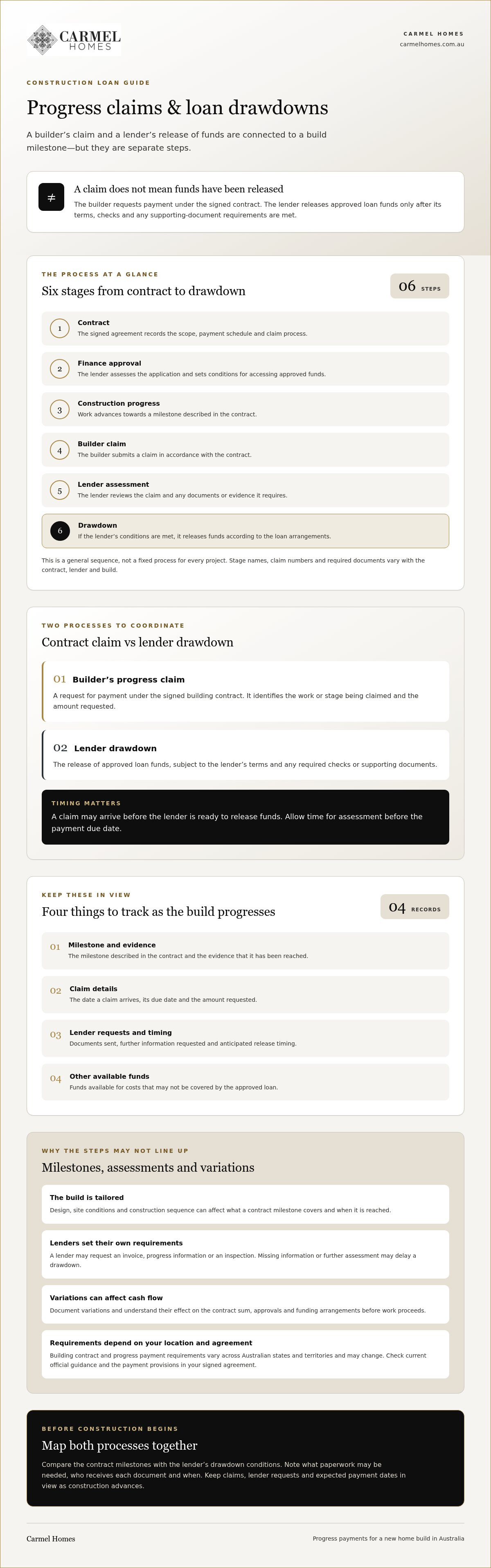
A builder’s progress claim is a request for payment under the signed building contract. It identifies the stage or work being claimed and the amount requested. A lender drawdown is the release of approved loan funds, subject to the lender’s terms and any required checks or supporting documents. Receiving a claim does not mean the funds have been released.
You coordinate the two processes as the homeowner. You may need to send the claim and supporting paperwork to the lender, respond to requests and allow time for assessment before the payment due date. The steps depend on your loan arrangements and contract, so compare both processes before construction begins.
Why a new-build payment schedule is not one-size-fits-all
Stage descriptions depend on the contract and the scope of the build. A tailored design, site conditions or construction sequence can affect what a milestone covers and when it is reached. Lenders set their own criteria for releasing funds, including the evidence or assessment they require. As a result, the contract claim and lender assessment may follow different processes, even when they relate to the same stage.
Requirements for building contracts and progress payments vary across Australian states and territories, and may change. Treat general descriptions of stages as a guide, not a substitute for the rules that apply to your location and contract. Check current official guidance for your state or territory and read the payment provisions in your signed agreement carefully.
Before work starts, map the contract milestones against the lender’s drawdown process. Note who needs to receive each document and when. As the build progresses, keep a record of:
the milestone described in the contract and the evidence that it has been reached;
the date a claim arrives, its due date and the amount requested;
documents sent to the lender, further requests and anticipated release timing; and
funds available for costs that may not be covered by the approved loan.
This is the foundation for understanding progress payments new home build australia. When you consider contract milestones and loan administration together, you can plan for upcoming payments and see how each one fits into the wider construction journey.
How Construction Loan Progress Payments Follow Build Milestones
A construction loan drawdown follows a sequence, but each step has a different purpose. The signed building contract sets out the stages and claims; the lender’s approval establishes the loan arrangements; and funds are released progressively, subject to the lender’s requirements. Knowing the sequence helps you prepare for the point when a construction milestone becomes a payment claim, then a separate request for loan funds.
Contract: The signed agreement records the scope, payment schedule and claim process.
Finance approval: The lender assesses the application and sets out the conditions for accessing approved funds.
Construction progress: Work advances towards a milestone described in the contract.
Builder claim: The builder submits a claim in accordance with the contract.
Lender assessment: The lender reviews the claim and any documents or evidence it requires.
Drawdown: If the lender’s conditions are met, it releases the relevant funds according to the loan arrangements.
This is a general guide, not a fixed sequence for every project. Stage names, the number of claims and the documents required vary with the contract, lender and build. For example, a lender may request an invoice, progress information or an inspection to assess a claim. The CommBank Construction Loan page explains one major Australian bank’s construction-loan process. Your own loan terms determine the requirements that apply to you.
From contract signing to the first construction claim
The contract and finance approval establish the framework for later claims, but signing alone doesn’t guarantee a drawdown. Before construction begins, compare the contract’s payment stages with the lender’s drawdown conditions. Note how each milestone is described, what paperwork may be needed and how to submit a claim. This helps you identify differences before the first payment falls due.
What may happen when a progress claim reaches the lender
After a claim is submitted, the lender may review the paperwork, assess construction progress or arrange an inspection, depending on its process. If information is missing or further assessment is needed, the drawdown may take longer. Allow for this possibility when planning around payment dates. Keep the builder’s claim, lender correspondence and supporting records together so you can respond to requests clearly.
A contract milestone establishes that a payment claim is being made under the building agreement. It does not, by itself, mean the lender has approved or released funds.
For anyone researching progress payments new home build australia, the practical point is to plan around both schedules rather than assume they move in lockstep. Carmel Homes provides full-service project management to guide clients through design, contract and construction milestones as the build progresses.
Comparing Payment Schedules, Contract Claims and Loan Drawdowns
To understand a payment stage, trace it through four points: what the contract says should happen, what the builder claims, what the lender checks and what you need to do next. The contract schedule governs the claim, while the loan terms govern the lender’s release conditions. Both processes can relate to the same construction milestone without following identical steps or timing.
What to compare in a progress-payment schedule
Read each milestone alongside the claim documentation and payment due dates. Check whether the wording reflects the actual scope and sequence of your build. A generic stage label may not describe all the work included. There is no single percentage split that applies to every project across Australia, so focus on the schedule in your contract and the requirements that apply to it.
How lender conditions can differ from contract milestones
A lender may require separate documents, a valuation or an inspection before releasing funds. This assessment is distinct from the builder’s claim under the contract. A claim does not, by itself, satisfy the lender’s conditions. Domestic building requirements can also vary between states and territories, so verify current rules for your location rather than relying on a schedule from another jurisdiction.
As you review the documents, use these questions to clarify timing and responsibility:
What work does each milestone cover, and what evidence supports the claim?
Who submits the claim and supporting documents to the lender?
What checks may be required before the drawdown, and how will requests be tracked?
What is the contractual due date, and how should a timing difference be managed?
Government grant schemes are separate from ordinary contract claims and loan drawdowns. For example, the Australian Government’s HomeBuilder Program provided grants for eligible new-home builds and renovations. A grant is not part of a lender’s progress-payment schedule. Keep grant arrangements distinct from the documents governing your build payments.
Comparing the contract schedule with the lender’s process gives you a clearer view of when money may be due and when loan funds may become available. This helps you plan cash flow more deliberately. This comparison is central to understanding progress payments new home build australia, particularly when contract dates, lender checks and construction progress don’t align neatly.
How to Prepare for Claims, Delays and Build Variations
A well-organised record makes a changing build easier to follow. Construction timing can shift, while a change to the agreed design or scope may affect the contract sum and the funds available under your loan arrangements. A clear process helps you see what has changed, what needs action and which dates to revisit.
A simple system for keeping payment records in order
Keep the signed contract, claims, written approvals, invoices, receipts and lender communications together in one secure, accessible record. A shared project timeline can help household members and the project team follow updates without relying on scattered emails or memory.
For every claim, record the milestone, date received, amount requested, contractual due date and current lender status. Note when documents are submitted, when the lender requests more information and when payment is made. This creates a clear history if you need to clarify a date or reconcile a claim later.
Log each claim: Match it to the relevant contract milestone and retain the supporting documents.
Track lender requests: Record what was requested, who is responding and whether anything remains outstanding.
Review dates: Compare the claim due date with the expected drawdown process, then update your cash-flow plan if timing changes.
File decisions: Keep written records of approved changes, revised documents, invoices and related correspondence together.
When timing or scope changes during construction
Weather, material availability, design decisions or other project developments may affect the construction sequence. A delay can change the expected timing of a milestone and its claim, but the effect depends on the circumstances and the contract. Update your timeline when dates change, and distinguish a revised estimate from a formal change to the agreed scope.
Document variations clearly so the revised work, contract sum and any relevant approvals are understood before the change proceeds. A variation may also affect the amount or timing of funds needed. Consider how it fits with your loan arrangements and follow the lender’s process for notifying it or providing updated information. Don’t assume that changing the building agreement automatically changes the lender’s assessment.
For a knockdown rebuild, planning can involve additional considerations around the existing home and the transition to a new build. A considered knockdown rebuild guide can help frame those early decisions as part of the wider project.
Before acting on a changed claim, compare it with the current contract documents, confirm what has been approved in writing and follow the lender’s process. This helps you plan progress payments new home build australia with greater clarity, even when dates or scope evolve.
If you’re considering a rebuild, explore Carmel Homes’ knockdown rebuild approach as you plan the project from its earliest stages.
How Carmel Homes Guides the Build Journey from Design to Completion
A custom home takes shape through connected decisions, from the first design conversations to construction and after-care. Clear milestones help you understand how the design is being translated into a build and how decisions about scope relate to the contract and project timeline. This can also help you organise questions about payment stages alongside your separate loan arrangements.
Carmel Homes is a family-owned Australian builder with more than 30 years of experience. Its bespoke design-and-build service brings design, construction and after-care together under a single project engagement. Full-service project management guides clients through each build stage, providing a framework for understanding what is being developed and what comes next. Project guidance does not replace lender approval or financial advice.
Bringing design decisions and construction stages into view
A tailored design needs to be translated into a coordinated construction plan. As the brief takes shape, decisions about layout, materials, finishes and the site contribute to the project scope. Considering that scope alongside construction milestones helps you understand how design intent connects with on-site progress.
This context can also help you follow claims. You can identify which stage a claim relates to and compare it with the agreed project documents, while your lender independently applies its loan conditions. Guidance through the build helps make decisions and milestones easier to follow, but it does not replace the lender’s assessment or financial advice.
Planning the next conversation about a custom home
If you’re starting a custom-home brief, bring together your aspirations, site context and preferred architectural direction. Consider how you want the home to function, which design details matter most and what you’d like to explore as the project develops. These starting points give the design conversation direction without requiring every detail to be settled at once.
Throughout a bespoke project, full-service project management helps keep design decisions, construction progress and upcoming stages visible as the home takes form. That continuity is valuable when your vision calls for a considered response rather than a generic plan, because the design and build can be understood as a connected whole.
Understanding progress payments new home build australia is one part of preparing for that journey. If you’re considering a home shaped around your priorities, Carmel Homes welcomes a conversation about your brief, your site and the architectural character you have in mind. From concept through construction and after-care, the team guides the project through each stage.
Shape Your Next Build Decision with Confidence
A new home begins with a vision, but a considered journey also needs a practical framework. As you think about progress payments new home build australia, clarify your priorities for the home, the character you want it to express and the site considerations that will shape its design. These foundations can help turn an ambitious idea into a clear brief.
From there, the design-and-build process brings architectural decisions and construction planning into focus, while your lender remains responsible for its own funding requirements. Keeping those roles distinct helps you approach the home and its financial arrangements with greater clarity, while staying focused on the personal qualities that make the project your own.
When you’re ready to explore a tailored home, start a custom design-and-build conversation with Carmel Homes. Your next conversation can be the beginning of a home shaped around the way you aspire to live.
Frequently Asked Questions
What are progress payments when building a new home?
Progress payments are instalments claimed as a new home reaches stages specified in its building contract. A claim might relate to a particular construction stage rather than arrive on a regular calendar date. The contract sets out how claims are made and what each payment relates to. Read the stage descriptions carefully so you can connect each requested amount to the work and terms documented for your project.
How do progress payments work with a construction loan in Australia?
With a construction loan, the builder’s claim and the lender’s release of funds are separate processes that need coordinating. When you receive a claim, follow the lender’s instructions for submitting it and any supporting material. Keep a record of requests and outstanding steps. As you research progress payments new home build australia, remember that loan approval does not necessarily make each later drawdown automatic. The lender releases funds subject to the loan conditions.
Are progress payment stages the same for every new home build?
No. Stages can differ according to the contract, the project scope and applicable state or territory requirements. A tailored home may have a different construction sequence or milestone descriptions from another build, so a schedule found online may not match your agreement. Use your signed contract as the reference for your project, and check current official guidance for the relevant jurisdiction before relying on general examples.
Does the bank inspect a home before releasing a progress payment?
Sometimes, but an inspection is not a universal step for every lender or drawdown. Depending on its process, a lender may assess documents, request information about construction progress, arrange an inspection or use another form of assessment. Review the conditions attached to your loan to understand what may be required for a particular claim. If an inspection is requested, allow time to arrange access and complete any related paperwork.
What happens if a progress claim is submitted before my loan funds are ready?
A claim may be due under the building contract while the lender’s assessment or drawdown is still in progress. Check the claim against your contract, follow up outstanding lender requests promptly and keep clear written records of dates and communications. Don’t assume the payment due date changes automatically because funding is delayed. If timing is uncertain, clarify the applicable process and responsibilities before the due date passes.
Can variations change progress payments on a new build?
Yes. A variation can affect the agreed scope, contract sum or timing of work, which may influence a later claim or funding assessment. Document the change and its financial effect, and understand how it must be approved under your contract before work proceeds. Notify the lender or provide updated information where its loan process requires it. The effect depends on the variation, contract terms and applicable requirements.
How can I plan cash flow for a construction loan build?
Start with a calendar that records each contract milestone, expected claim, payment due date and relevant lender step. Update it when construction dates or approved scope change, and separately note costs that may need to be funded outside the loan. If a claim date moves, review both your household budget and the lender’s process rather than relying on the original estimate. Regular record-keeping can make upcoming commitments easier to anticipate.


