


Understanding your building contract, from deposits to protections
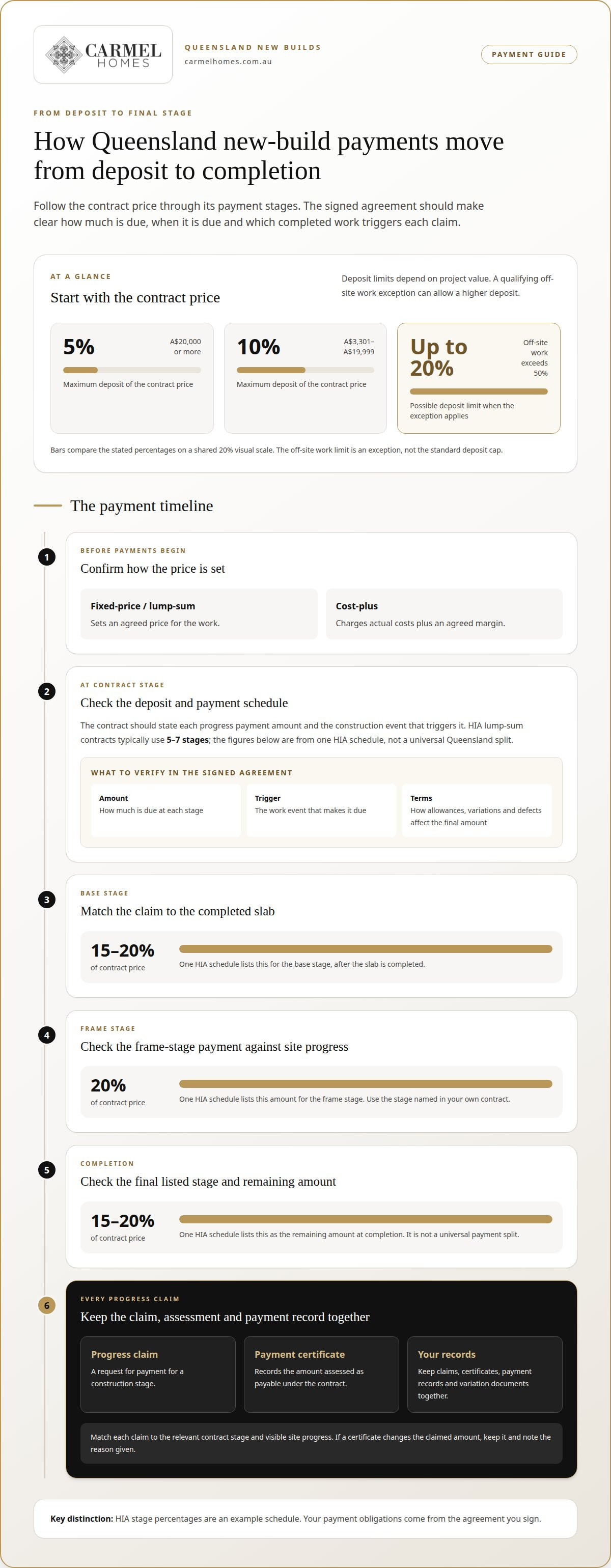
For a Queensland new build, the deposit is generally capped at 5% of the contract price for projects valued at A$20,000 or more, and 10% for projects from A$3,301 to A$19,999. A deposit may be up to 20% where off-site work exceeds 50%. Understanding your building contract in 2026 means looking beyond the deposit to the payment schedule, insurance, warranties and terms that shape your obligations.
It’s natural to focus on the initial payment, but the finer details of a building contract can matter just as much once work begins. Understanding the terms helps you see how payments relate to progress, what protections apply and how changes or delays are handled.
This guide explains key Queensland rules and clauses to understand before signing, including deposit limits, statutory warranties, home warranty insurance and contract requirements. It also explains how independent building advice can help you assess the agreement and make informed decisions about your new home.
Table of Contents
What limits apply to deposits and progress payments on a new build?
In Queensland, deposit limits depend on the contract price, with a higher limit for qualifying off-site work. The contract type and stage schedule also determine how payments relate to the agreed price.
Deposit limits
A deposit is the initial payment under a domestic building contract, and its legal maximum depends on project value. For Queensland projects valued at A$20,000 or more, the cap is 5% of the contract price; from A$3,301 to A$19,999, it is 10%. A deposit may reach 20% where off-site work exceeds 50%.
Residential agreements may use fixed-price, also called lump-sum, or cost-plus pricing. A fixed-price contract sets an agreed price; cost-plus charges actual costs plus an agreed margin. Victoria allows cost-plus contracts only for projects worth A$1 million or more. Thresholds vary by jurisdiction: Queensland regulated contracts apply above A$3,300, NSW distinguishes A$5,000-A$20,000 work from contracts over A$20,000, and Victorian written-contract requirements apply from A$10,000.
Progress payment schedules
A progress payment schedule divides the contract price into payments due at specified construction stages. Check that the signed contract clearly states each amount and the event that triggers payment, rather than leaving you to guess when funds are due.
HIA lump-sum contracts typically use 5-7 stages. One HIA schedule lists 15-20% for the base stage after the slab is completed, 20% for the frame stage, and the remaining 15-20% at completion. These figures describe that schedule, not a universal Queensland payment split. Compare each scheduled claim with the work stage named in the contract, and note how allowances, variations and any defects affect the final amount.
Progress claims and payment certificates
A progress claim requests payment for a construction stage, while a payment certificate records the amount assessed as payable under the contract. The claim process should link the requested payment to completed work and a documented stage.
Read the signed payment terms for the required claim details, assessment process and due date. Match each claim to the relevant stage and the progress visible on site. If a certificate adjusts the claimed amount, keep it and note the reason given. HIA stage schedules can be a useful point of comparison, but your payment obligations come from the agreement you sign. Keep claims, certificates, payment records and variation documents together so you can track the contract price as construction progresses.
What are statutory warranties and home warranty insurance in Queensland?
Queensland statutory warranties cover specified building obligations, while home warranty insurance provides separate protection. Dispute options and insurance terms depend on the contract and the applicable scheme.
Builder registration and warranties
A builder’s registration record can help establish whether their approved scope covers the proposed residential building work. Check that the project specifications and agreed responsibilities are clear before construction starts.
For regulated domestic building contracts, statutory warranties last 6 years for structural defects and 1 year for other breaches. They set standards for the work beyond the wording of individual specifications. For projects valued at A$20,000 or more, the contract must state the start date, practical completion date and statutory warranties. Keep the signed agreement and completion records together, so the relevant obligations can be understood if defects arise.
Insurance and dispute protections
Queensland home warranty insurance is compulsory for residential building work valued over A$3,300. The Queensland Home Warranty Scheme covers eligible work up to A$200,000, subject to limits and exclusions. Its cover lasts 6 years and 6 months, measured from the earliest of the premium being paid, the contract being entered into or work starting. Cover attaches to the property if it is sold.
This protection is distinct from building insurance, which concerns insured damage to the property rather than a builder’s contractual obligations. Read the contract’s insurance clauses for the risks and responsibilities they address. Elsewhere in Australia, NSW uses Home Building Compensation insurance, while Western Australia requires Home Indemnity Insurance for most residential building work over A$20,000. WA cover does not protect against poor workmanship while the builder remains operating and able to fix it. For a Queensland dispute, retain the contract, correspondence, payment records and defect details; those documents help establish what was agreed and where the disagreement lies.
What must a new build contract include in Queensland?
Queensland gives buyers of regulated domestic building contracts a cooling-off period of 5 business days. The period starts the day after you receive the signed contract and, for work valued at A$20,000 or more, the QBCC Consumer Building Guide. Check when both documents arrive, because their timing affects when the period begins.
If you withdraw during that period, you generally pay A$100 plus the contractor’s reasonable out-of-pocket expenses. This is a defined withdrawal cost, rather than the full contract price. Keep the signed agreement, the date you received it, the Consumer Building Guide where applicable, and any cancellation correspondence together. These records help establish the dates and terms relevant to your decision.
Getting a lawyer to review the contract before signing can affect your protection: a builder may not provide a cooling-off period if you engaged a lawyer for a review beforehand. The sequence matters. Decide whether to seek legal advice before signing, then understand how that choice relates to the cooling-off clause and your ability to withdraw. Cancellation rights can differ between residential agreements.
Contract form also depends on the value of the residential building work. Contract requirements can vary with the scope and value of residential building work, so check which form applies before work starts. Regulated domestic building contracts for work valued above A$3,300 must be written, dated and signed by both parties before construction begins. Before signing, read the cancellation clause alongside the project description, agreed price and payment terms. If you withdraw, communicate the decision clearly and retain a copy with the contract documents.
Contract review and independent building advice
A careful approach to understanding your building contract in 2026 begins with seeing how the signed agreement translates your design into construction obligations. Owners can commission legal advice on contract terms and building expertise on practical details, including whether plans, specifications, inclusions and exclusions align. Reviewing these together can reveal gaps before they affect decisions, costs or the finished home.
Focus on the provisions that shape the project from commencement to completion. Check how the domestic building contract describes the work, agreed price, allowances, timing, inspections, insurance and dispute processes. Confirm that the home warranty insurance documents relate to the property and building work described. The clauses must also match the plans and specifications attached to the agreement. Clear documentation is just as vital for interior fitting-out and renovation projects, where specialist teams such as JM & SONS General Contractor Pte Ltd demonstrate how precise scopes prevent ambiguity across residential and commercial works.
Pay particular attention to variations, as a design change can affect both price and timing. In Queensland, a contractor must provide a written variation stating any price change and delay before the changed work starts, except in urgent situations. The owner must receive a copy of the residential variation document within five business days after agreeing to it. Keep the document with the original contract to record what changed and when.
Review delay provisions as carefully as variation terms. A Queensland contractor must submit an extension-of-time claim within 10 business days after becoming aware, or reasonably expected to become aware, of the cause and extent of delay. For practical oversight, owners can compare construction progress with scheduled stages and keep inspection notes, photographs and correspondence together. A sound approach to understanding your building contract in 2026 also means maintaining records that distinguish an agreed change from an unresolved concern.
Before signing, prepare a short list of unclear clauses and have each addressed in writing. For a home shaped around your own plans and priorities, discuss your project requirements as part of your next planning conversation.
Carmel Homes: Custom Design and Build
Carmel Homes offers Custom Design and Build for homeowners whose plans call for a considered, individual approach. Once you are understanding your building contract 2026 protections and payment terms, this can be the natural next step if you want your home’s design and construction shaped around your priorities rather than a standard plan.
Whether you are planning a Knockdown Rebuild , considering French Provincial Luxury Homes or exploring Modern Custom Home Designs , start by defining your vision and how you intend to live. A clear brief connects architectural choices with the practical decisions that will appear in your plans and contract.
For a considered conversation about your proposed home, contact Carmel Homes or visit carmelhomes.com.au.
Carry your vision into the next conversation
Understanding your building contract in 2026 is part of a larger decision: defining what a home should make possible for the people who will live in it. As you move from reviewing terms to shaping a design, keep your priorities visible, from how rooms should support daily life to the character and materials that will give the residence its enduring identity.
Carmel Homes’ bespoke design and construction approach gives you room to explore your ideas and consider how they could take shape. A first conversation can help clarify your direction, whether you are planning for a new site or an existing property. Bring the aspirations, practical needs and architectural references that matter to you as a starting point for a home shaped around your life.
Contact Carmel Homes to begin discussing your vision. With considered decisions and a clear design direction, you can move towards a home that feels distinctly your own.
Frequently Asked Questions
How does a building contract handle variations and changes?
A building contract should explain how proposed changes are priced, approved and recorded. For example, if you request a different kitchen layout, the variation document should identify the revised work, any price adjustment and the effect on timing. In Queensland, the contractor must provide the written variation before the changed work starts, except in urgent situations. Keep the agreed document with the original plans.
Trap 4: Completion and Delay Clauses, Who Pays for Wait Time?
The contract’s delay clauses determine how extensions and costs are treated, so read the notice requirements alongside the completion date. A delay caused by an owner’s late selection may be treated differently from an unexcused builder delay. Some contracts set liquidated damages of A$100-A$250 per calendar day for unexcused delays. Check what events qualify, how notice must be given and when any amount becomes payable.
What are prime cost items and provisional sums?
Prime cost items are allowances for goods selected later, such as bathroom tiles. Provisional sums are estimates for work whose scope or cost is not yet settled. The distinction matters because the final contract amount may change once selections are made or the work is priced. Compare each allowance with your intended finish, and clarify how any difference will be calculated and documented.
What are the process steps when a solicitor reviews a building contract?
A solicitor typically reviews the agreement alongside its plans, specifications and schedules, then identifies legal obligations, risks and unclear terms. They can explain clauses on payment, completion, variations, termination and disputes, and suggest questions or amendments to discuss before signing. Provide the complete document set, including referenced attachments, so their advice covers the agreement as a whole.
What happens when the plans or specifications change?
Changes to plans or specifications can affect the scope, price and construction timing, so assess them before revised work proceeds. For example, changing window sizes may require updated drawings and a written variation describing the change and its consequences. Ensuring clear technical documentation is a principle emphasised across the glazing industry by specialists such as A ACME Design, who highlight how exact measurements prevent fitting issues. Keep the amended plans with the variation, and make sure the documents clearly show which design version governs the work.
What is the cooling-off period?
A cooling-off period gives a buyer a limited opportunity to withdraw from certain regulated contracts after receiving the required documents. In Queensland, the period starts the day after the signed contract arrives, and for work valued at A$20,000 or more, after the QBCC Consumer Building Guide is received. Signing alone does not necessarily mark day one, so retain the delivery dates and cancellation correspondence.


