


What to Expect During a Custom Home Build: A Considered Guide
Updated: Oct 13
Understanding what to expect during a custom home build helps turn a series of unfamiliar stages into a clearer plan. Once the design is agreed, construction brings new decisions, site activity and milestones. Knowing what happens at each stage, what input the team may need from you and how changes are handled can help you stay involved without having to manage the work yourself.
Every home and site is different, so the exact sequence and timing will depend on the project. The broad stages, however, are a useful guide: approvals and site commencement, foundations, framing, services, finishes, completion and handover. Clear communication helps connect these stages with the decisions you need to make, and gives you a way to raise questions when something needs attention.
This guide explains what to expect as construction progresses, how to prepare for selections and changes, and what handover means for you as the homeowner. Carmel Homes is a family-owned custom home builder with over 30 years of experience, providing bespoke design-and-build services and full-service project management from concept through construction and after-care.
Table of Contents
What to expect during a custom home build once construction begins
Once construction begins, the approved plans and project documentation guide the work on site. The design stage establishes what the home will be; construction turns that agreed design into a finished home. Your plans provide the reference point for the build, while project coordination connects the individual tasks and decisions.
For homeowners considering what to expect during a custom home build, it helps to know that construction follows a sequence without being identical from one project to another. The design, site conditions and decisions required along the way all shape the work. As boutique property specialists and builders such as Galloway Realty often highlight, a custom home is designed for its particular block and owners, so its construction will reflect those requirements rather than follow a standard plan in exactly the same way.
Where construction sits in the wider custom home journey
Design development and relevant approvals generally precede on-site construction. By commencement, the agreed plans and supporting project documentation provide a basis for organising the work. They help the project team coordinate the tasks involved, from initial site activity to the details that bring the home to completion. For a broad overview of the phases of construction, this reference provides general context. The plans and requirements for your own project remain the practical guide.
Construction is not a return to the beginning of the design process. It is the realisation of decisions already developed. If a detail needs clarification, raise it through the agreed communication channel so the team can explain how it relates to the plans and work under way. Keeping questions connected to the project documentation helps everyone refer to the same information.
What a homeowner contributes during the build
Your role is to stay involved in decisions that need your input, not to manage every trade or coordinate daily site activity. The project team organises the work. You can help keep decisions moving by reviewing requested information, giving clear feedback and responding within the timeframes discussed for your project.
At the outset, make sure you understand how updates will be shared, who to direct questions to and how decisions should be recorded. When feedback is specific and consolidated, it is easier for the team to understand your preferences and respond in context. If you need more time to consider an option, say so early and ask what the timing means for related work.
Set aside time to review selections and project information when requested.
Send questions and feedback through the agreed communication channel.
Record decisions clearly, and let the team know if you need further discussion before responding.
With full-service project management, Carmel Homes guides clients through each stage of the build and coordinates construction activity with the decisions that require their input. This lets you remain involved in shaping your home without taking on the task of directing each trade. The process is tailored to the design and site, rather than treating every build as identical.
Custom home build stages: from site preparation to enclosed structure
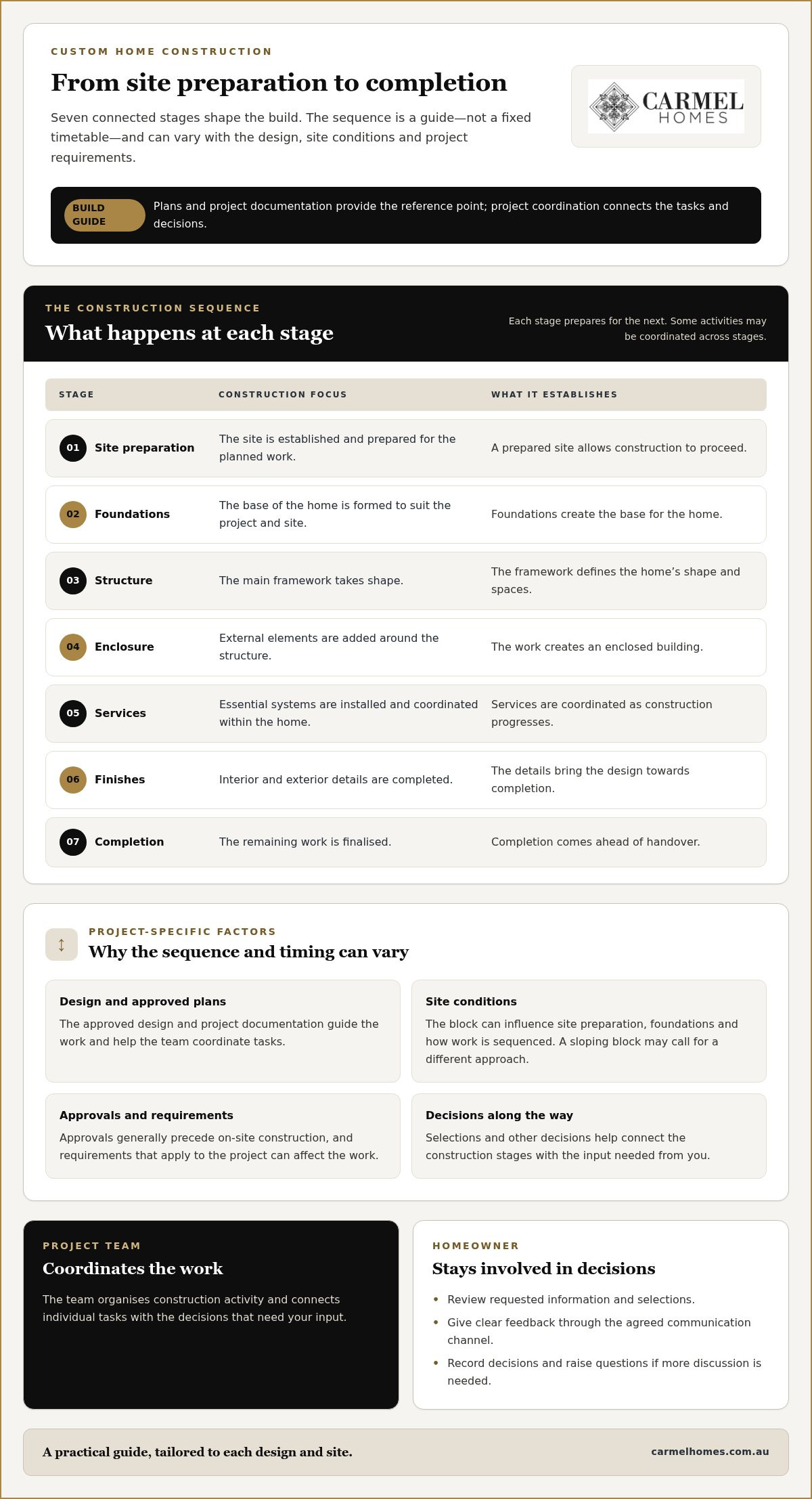
A custom home takes shape through connected stages, with each one preparing for the next. This sequence is a useful guide to what to expect during a custom home build, but the work and timing can vary according to the design, site conditions and approvals. A sloping block , for example, can require a different approach to site preparation and foundations from a more straightforward site.
Broadly, construction establishes the site, creates the structure, encloses the building and completes its interior and exterior details. The typical sequence is:
Site preparation: The site is established and prepared for the planned work.
Foundations: The base of the home is formed to suit the project and site.
Structure: The main framework gives the home its shape and defines its spaces.
Enclosure: External elements are added to create an enclosed building.
Services: Essential systems are installed and coordinated within the home.
Finishes: Interior and exterior details bring the design to completion.
Completion: The remaining work is finalised ahead of handover.
This sequence is a guide, not a fixed timetable. The order and detail of activities depend on the approved design, conditions encountered at the site and requirements that apply to the project. Some tasks may be coordinated across stages, too. As a result, visible progress will not always look like a simple step-by-step transformation.
Early construction: preparing the site and establishing the structure
At the start, the site is organised and prepared so construction can proceed. Foundations are an important early milestone because they create the base for the home. As structural work follows, the outline of rooms and the scale of the design become easier to see. Site conditions influence how this work is sequenced, which is why a general duration cannot describe every custom build.
Enclosure, services and interior finishes
After the primary structure is in place, external elements are added to enclose the home. The frame begins to read as a building, while work continues inside. Services are coordinated as construction progresses, followed by interior and exterior finishes that give each space its intended character.
Between visits, the site may look noticeably different. At other times, progress may be less visible while work is happening inside the structure. Visible change is only one way to understand progress. Project updates can explain what stage is under way, what has been completed and what follows. Carmel Homes’ full-service project management coordinates construction with the agreed design. Its custom home build service brings design and construction together under one project engagement.
Custom home build decisions, variations and progress updates
A planned selection is part of the agreed work of building a home. A request to change an agreed plan or detail is different. Understanding the distinction is central to what to expect during a custom home build because the effect of a decision depends on what it changes and when it is raised. A selection made at the relevant stage can be coordinated with upcoming work. A later change may require discussion about documentation, sequencing or work already completed.
The comparison below outlines general considerations. The exact process depends on the project and its agreed documentation.
How selections and client decisions fit into construction
Finishes and fixtures are selected at relevant milestones, when the project is ready for those choices to inform the next steps. The schedule depends on the project, so there is no single set of selection deadlines for every custom home. Take time to consider the options, and provide a clear response when requested. That gives the team a definite choice to coordinate with related work and avoids uncertainty about your preference.
What to understand before requesting a change
A change can affect more than the detail you want to reconsider. Revising a finish may prompt a discussion about related selections. Altering an agreed plan may require the documentation or sequencing to be reviewed. The implications depend on the request, its timing and the work already under way. Before approving a change, ask the project team to explain its implications and the next steps, then review the information provided.
Keep a clear record of selections, questions, decisions and agreed next steps using the project’s established communication process. This gives you and the team a shared reference, especially when several choices are being discussed at once. If an update raises a question, send it through the agreed channel so it can be considered in the context of the project rather than relying on informal messages that may not capture the full decision.
Use progress updates to understand what has been completed, what is approaching and whether a decision is needed from you. A useful update connects visible progress with the choices that support upcoming work. Carmel Homes’ full-service project management coordinates construction and client decisions as part of a tailored process, keeping communication connected to the work as your home takes shape.
How to stay prepared and confident during a custom home build
You do not need to oversee every activity on site to stay involved in your build. Focus on keeping informed, responding thoughtfully when a decision is needed and raising questions through the agreed communication process. Clear records and timely decisions give you and the project team a reliable reference as work progresses.
A practical checklist for clients
Keep current project documents and written decisions together in one place, such as an organised digital folder or a file you can readily access. Before responding to a request, review the information, note anything that needs clarification and state your decision clearly. This makes it easier to distinguish a confirmed choice from an open question or a discussion still in progress.
Organise records: Keep project information, selections and written decisions easy to find.
Review before responding: Read the relevant details and gather your questions so your feedback is considered and specific.
Raise queries early: If something is unclear, bring it to the project team’s attention through the established channel.
Confirm next steps: Note who is doing what and whether a further decision or response is needed from you.
These habits are particularly useful when several decisions are in motion. A brief written record helps distinguish a confirmed selection from an option still under consideration. Raising a question early also gives the team an opportunity to explain how it relates to the work under way.
Following progress without taking over the site
Scheduled updates help you understand what has progressed and which decisions may be coming up. They also give you an opportunity to ask about something unexpected. Construction involves changing site conditions and coordinated activity, so a change in what you see between visits may reflect the next task or work happening out of view.
Raise a question promptly if something appears inconsistent with information shared by the project team, or if you think a decision may be needed before work proceeds. You do not need to diagnose the issue yourself. Describe what you have noticed and ask for context through the agreed communication process. The team can explain whether it needs attention and what happens next.
Visit the site only in line with the project team’s arrangements and safety guidance. An active building site is a work environment, and access instructions help ensure visits are appropriately coordinated. Regular updates can keep you connected to progress without requiring you to manage trades or attend the site to monitor day-to-day activity.
If your project involves replacing an existing home, the knockdown rebuild guide provides more information about that pathway. You can also read about Carmel Homes’ custom home building process.
From construction milestones to handover with Carmel Homes
Project management connects the many moving parts of a build. Site activity, upcoming milestones and client decisions are coordinated so the work is more than a series of separate tasks. For homeowners considering what to expect during a custom home build, this continuity helps explain how decisions relate to progress and what needs attention as the home approaches completion.
What completion and handover mean for the homeowner
Completion marks the transition from active construction towards review, finalisation and taking possession of your home. As the work draws to a close, attention shifts from coordinating construction to the finished home and the handover arrangements for your project. Those details are specific to the agreed contract and build, so refer to the arrangements set out for your home rather than assuming every handover follows an identical procedure.
Handover is also a chance to become familiar with your home as a finished place, not just as a series of construction milestones. You can orient yourself to its spaces and features, raise questions through the established project communication process and understand the next steps set out for your handover. Taking time to understand the transition helps you move from construction to living in the home with a clear sense of what comes next.
Handover does not necessarily mark the end of the relationship. The guidance that follows construction can be part of the wider client journey. The agreed project arrangements provide the reference point for any follow-up as you settle into your home.
A tailored build supported from concept to after-care
Carmel Homes is a family-owned Australian builder with over 30 years of experience, managing bespoke design-and-build projects from concept through construction and after-care. Its full-service project management connects decisions made along the way with milestones on site, maintaining a clear thread between the original vision and the completed home.
A tailored approach recognises that a distinctive home cannot be reduced to a standard sequence. The design, site and your priorities shape the work, while project management coordinates those elements as they come together. Carmel Homes guides clients through each stage, from early design conversations to construction and after-care.
To start shaping a home around your needs, discuss your custom home vision with Carmel Homes. A conversation can help bring your priorities into focus and identify a practical next step.
Give your vision a thoughtful next step
A custom home begins with more than a floor plan. It starts with understanding how you want to live, what matters in your daily routines and which qualities you want your home to have. Clarifying those priorities can make early conversations more focused and help ensure the design reflects how you plan to use the home.
Knowing what to expect during a custom home build can also help you approach those conversations with a steadier perspective. You do not need every detail resolved before you begin. A considered discussion can bring your ideas into focus, explore how they relate to your project and identify a practical next step.
Ready to start shaping your ideas? Discuss your custom home vision with Carmel Homes and take the first step towards a home designed around the way you want to live.
Frequently Asked Questions
How long does a custom home build take in Australia?
There is no single timeframe for every custom home build in Australia. The schedule depends on factors such as design complexity, site conditions, approvals, construction sequencing and how decisions progress. Use the project-specific programme as your reference and discuss how a proposed change may affect upcoming milestones. That gives you a more useful basis for planning personal arrangements around the build than a general estimate.
What happens if weather delays construction?
Weather can make some site activities unsuitable or unsafe, so the project team may need to pause or rearrange work. The effect on progress depends on the conditions, the construction stage and which tasks can continue. Follow project updates for revised expectations, and note any changes to milestones or decisions needed from you. The team can explain how the conditions affect your build.
Can I visit my home while it is being built?
Site visits may be possible when arranged through the project team and carried out under its access and safety guidance. An active building site can contain hazards and changing work areas, so do not enter independently or assume access is available at any time. Arrange visits in advance, follow the instructions provided and ask which areas are appropriate to view. Scheduled updates can also help you follow progress between visits.
What should I do if I want to change something after construction starts?
Raise the request through the project’s established communication process before work proceeds on the change. Describe the detail you want to reconsider, then ask the project team to explain any implications for drawings, related selections, sequencing, budget or work already completed. Review the proposed outcome and next steps, and keep a written record of the decision. This helps everyone work from the same understanding before changes are made.
Do I need to arrange building approvals for a custom home?
Approvals are generally needed before relevant building work can proceed, but requirements and processes vary between Australian states and territories and according to the project. Your design-and-build agreement sets out responsibilities for your project. Carmel Homes manages bespoke projects from concept through construction with full-service project management, guiding clients through each stage of the build. Review the project arrangements to understand how approvals fit into the scope and what information or decisions you need to provide.
What is practical completion in a custom home build?
Practical completion is a project milestone defined by the building contract, generally marking the point when the home is considered substantially complete under the agreed terms. It is distinct from simply reaching the last visible construction stage. The contract sets out how the milestone is assessed and how any outstanding items are handled. Review those provisions with the project team so you understand what practical completion means for handover and the steps that follow.
Can I live on the property while my custom home is being built?
It depends on the project and whether the existing dwelling can remain safely separate from the construction area, with access and services managed appropriately. For a knockdown rebuild , you will need to plan to live elsewhere once the existing home is demolished and construction begins. For other projects, arrangements depend on the site and work involved. Discuss your living plans early so they can be considered alongside the project’s staging and site arrangements.


